
Unified KMS API: Real-Time Access to Knowledge Base and Documentation Data
·
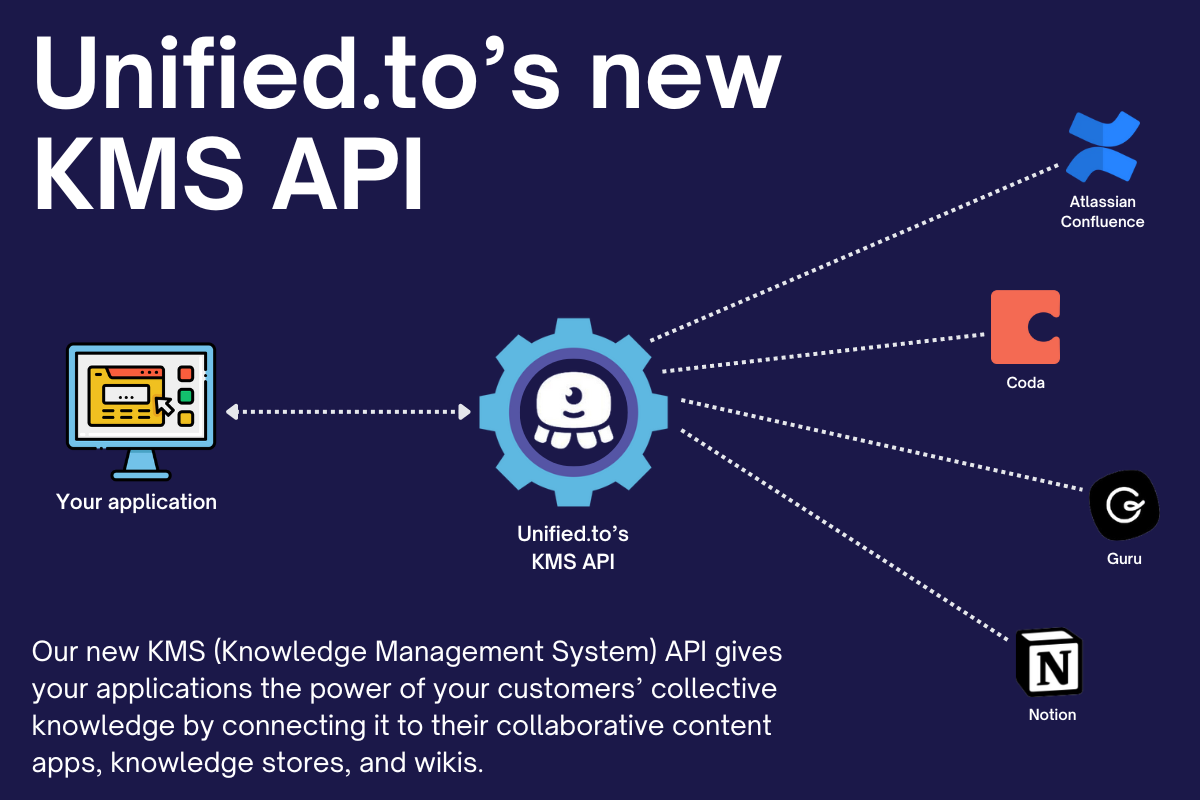
If your product needs access to internal documentation, help center content, or knowledge bases, you quickly run into fragmented APIs, inconsistent content structures, and provider-specific data models.
The Unified KMS API provides a single interface to retrieve and manage knowledge content across platforms, with normalized objects and real-time access. It acts as a unified knowledge layer across documentation and help center systems, enabling applications to access and structure content through one API.
Supported platforms
The KMS API supports 32 integrations, including:
- Atlassian Confluence
- ClickUp
- Coda
- Freshdesk
- Gladly
- Guru
- Helpscout
- Intercom
- Microsoft SharePoint
- Notion
- Salesforce
Additional knowledge base and help center integrations are expanding as part of this category.
Unified knowledge model across platforms
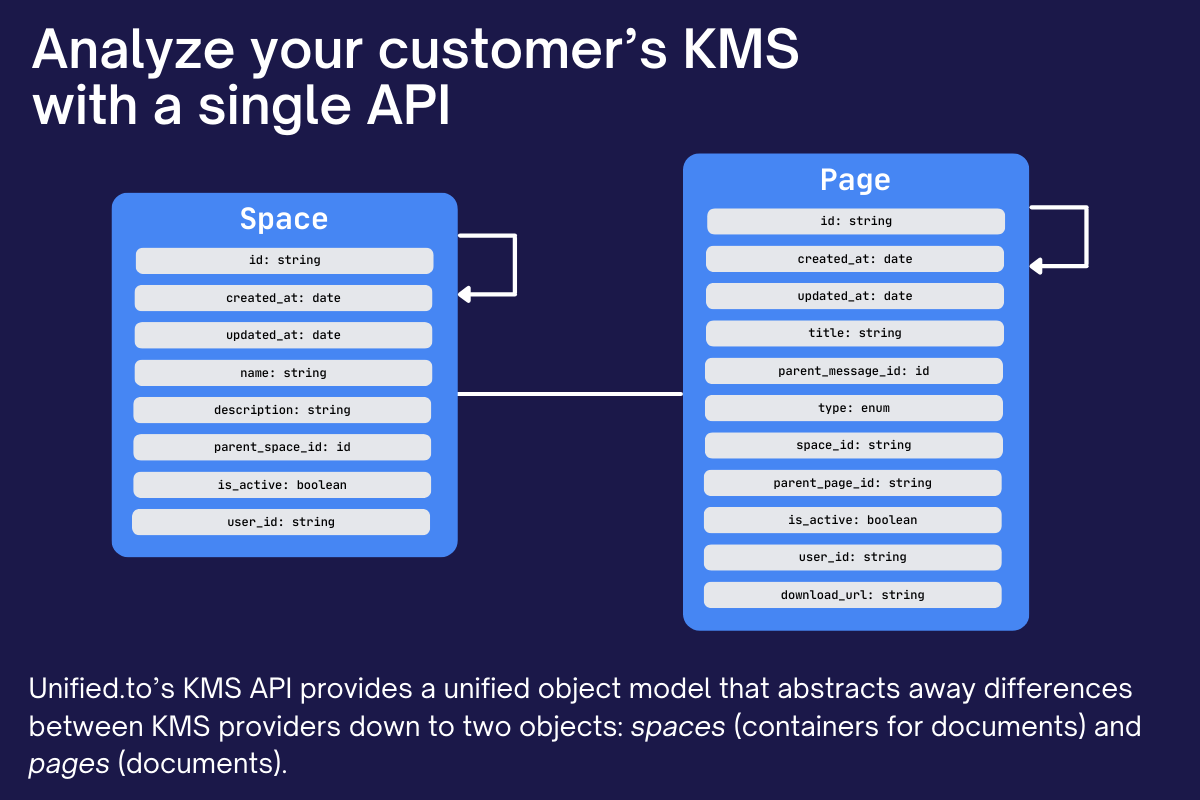
The KMS API standardizes content across providers using a consistent object model:
- Spaces: collections of documents (folders, workspaces, or knowledge bases)
- Pages: individual documents or articles, including hierarchical relationships
Content, structure, and hierarchy are normalized across providers, reducing the need to map platform-specific formats.
Core objects in the KMS API
- Spaces: containers for knowledge content
- Pages: documents and articles
- Comments: discussions and annotations on content
These objects follow consistent schemas across providers, reducing the need to handle platform-specific content structures.
Real-time access to knowledge data
The KMS API retrieves and updates content in real time:
- Requests are routed directly to source platforms
- No polling or background jobs
- No stored copies of customer data
Webhooks provide updates for changes to content and structure.
What teams build with the KMS API
- Unified search across knowledge bases and documentation
- Internal tools accessing company knowledge across platforms
- Help center aggregation across support systems
- AI assistants powered by documentation
- Content pipelines syncing knowledge into internal systems
Using knowledge data in AI systems
Knowledge base content can be used to:
- Generate summaries of documentation
- Power search and question-answering systems
- Extract structured data from unstructured content
- Provide context for AI agents and copilots
Because content is accessed in real time, AI systems operate on current information.
Who this is for
- Internal tools accessing company documentation
- Support platforms aggregating help center content
- Search systems indexing knowledge bases
- AI systems using documentation as context
- Analytics platforms processing knowledge usage
What is a knowledge management API?
A knowledge management API allows developers to access and manage documentation, knowledge bases, and internal content across platforms through a single interface. It standardizes how content is retrieved, structured, and updated across providers.
Get started
The KMS API is available on all Unified plans.