
TheevolutionofAPIintegrationplatforms
From the 1970s to 2026 — here's how integration technology has evolved and why engineers are choosing Unified.to to power integrations for AI and SaaS today.
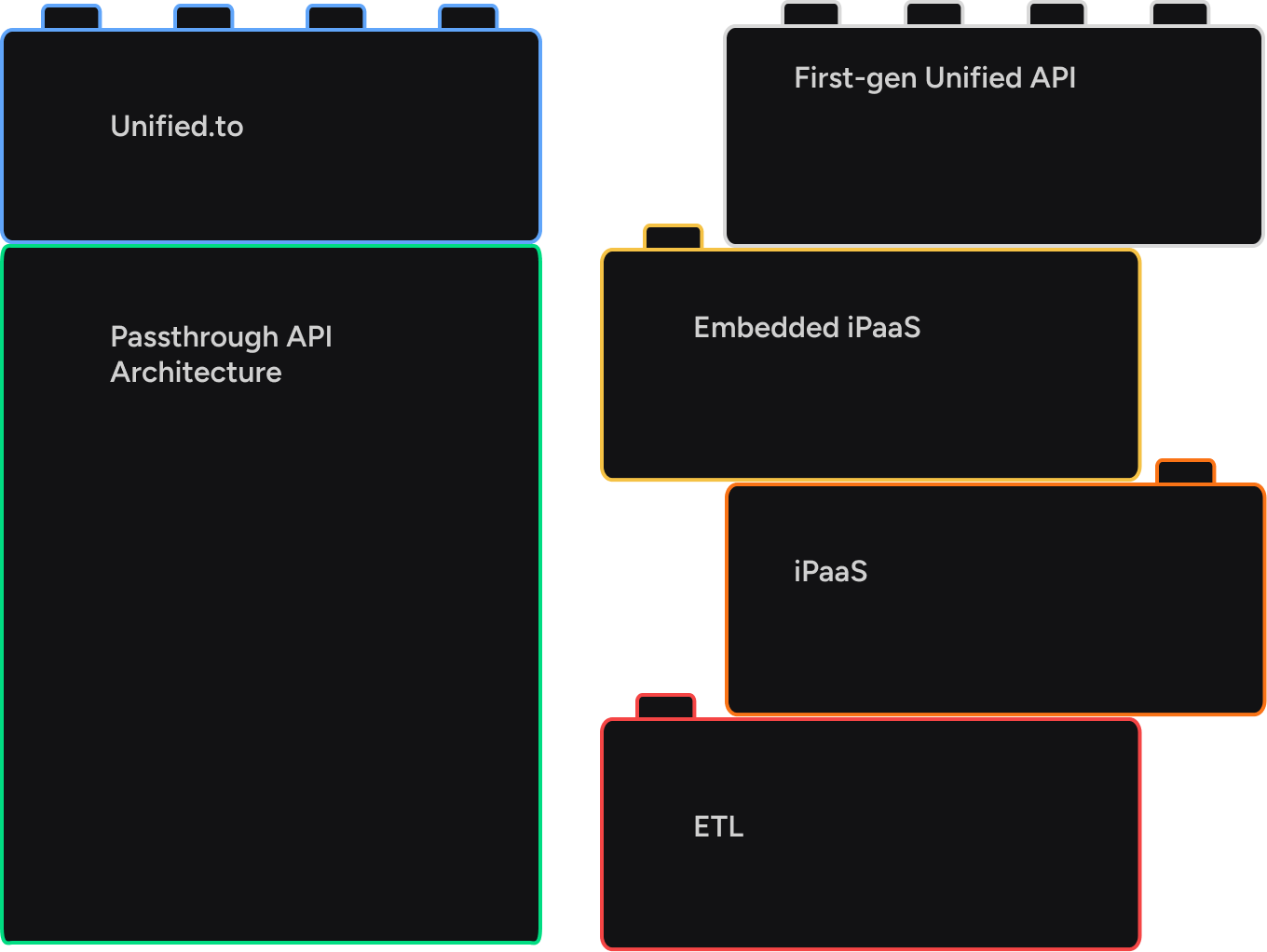
Unified.to versus Unified API, iPaaS, and ETL solutions
Discover the differences between integration solutions and how Unified.to outpaces alternatives in real-time data access, launch speed, maintenance, and AI usefulness.
ETL
- ApproachDesigned 40+ years ago, ETL moves data by extracting it from a database, transforming it, and loading it into another. Data moves in batches at scheduled intervals and notably not in real-time.
- Real-time DataBatch processing may delay data updates by up to 24 hours.
- Launch SpeedETL processes must be designed, tested, and scheduled for each source and destination, leading to slower launches.
- SecurityCaching data during batch transfers increases security risks by temporarily exposing customer data outside the originating system.
- Level of UnificationNone
- MaintenanceETL processes need ongoing monitoring and adjustments to maintain pipeline integrity.
- AI UsefulnessETL is inefficient for training or fine-tuning AI due to the absence of clean, normalized, real-time data.
- AuthorizationNot applicable. Pipeline-level credentials only; no end-user authorization.
- Pricing ModelPricing tied to hardware, software, or custom configurations, with high costs from manual maintenance of legacy systems.
iPaaS
- ApproachiPaaS was the first to enable integrations with SaaS platforms, but retains the batch-processing approach. While providing more flexibility than ETL, it's still limited by the lack of real-time data.
- Real-time DataBatch processing may delay data updates by up to 24 hours.
- Launch SpeedEach integration requires unique configuration for its API and data model, slowing high-volume launches.
- SecurityCaching data during batch transfers increases security risks by temporarily exposing customer data outside the originating system.
- Level of UnificationNone
- MaintenanceiPaaS platforms manage most backend maintenance but still require oversight.
- AI UsefulnessiPaaS is inefficient for training or fine-tuning AI due to the absence of clean, normalized, real-time data.
- AuthorizationPer-connector credential vaults; OAuth flows and scopes vary by vendor are are all custom and external. Admin setup can be heavy; multi-tenant isolation depends on the platform.
- Pricing ModelFlat-rate or task-based pricing, but scaling remains costly due to outdated architecture.
Unified API
- ApproachThis Unified API enables multiple integrations and standardizes data with one data model and API. However, its reliance on batch processing and storage results in delays when data is updated.
- Real-time DataBatch processing may delay data updates by up to 24 hours.
- Launch SpeedShallow unified data schemas often require custom development, delaying launches as developers work to map and align data models effectively.
- SecurityCaching data during batch transfers increases security risks by temporarily exposing customer data outside the originating system.
- Level of UnificationPartial unification due to shallow data models.
- MaintenancePartial unification increases technical debt for engineers.
- AI UsefulnessNon-real-time and partially unified data impede efficient AI model training.
- AuthorizationIntegration-specific OAuth/API keys; token refresh and scope mapping typically left to your team or SDKs; higher risk of over-scoped access.
- Pricing ModelTiered or contract-based pricing, but challenging to align costs with actual usage.
Unified.to
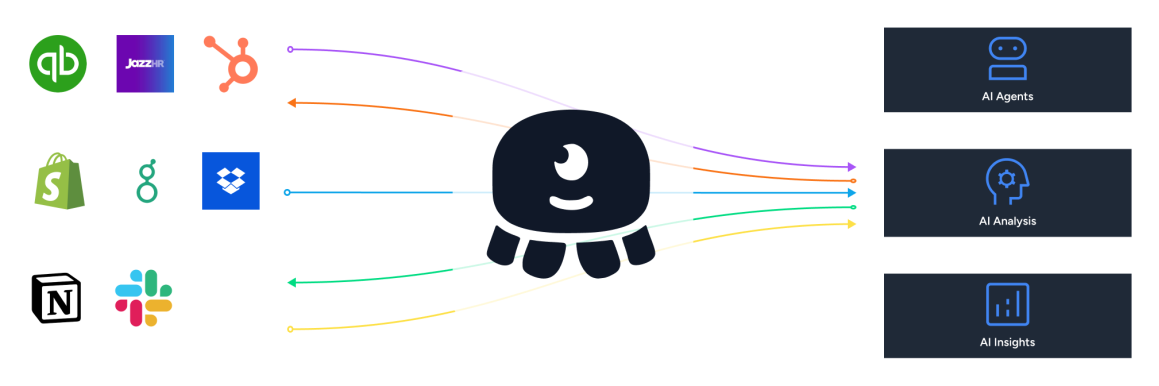
- ApproachUnified.to's Real-time Unified API combines unified API capabilities with real-time data access. By eliminating batch processing and storage, it ensures continuous, direct, and up-to-date data flow.
- Real-time DataData is delivered in real time and on demand, ensuring live availability.
- Launch SpeedMinimal setup with no data model transformation required, as Unified.to's APIs deliver clean, normalized, real-time data, enabling high-volume launches in days.
- SecurityUnified.to ensures the security of transmitted data by never caching or storing it.
- Level of UnificationUnified.to is fully unified: API endpoints, data models, webhooks, permission scopes, and authorization.
- MaintenanceZero maintenance burden as Unified.to fully manages API changes and updates. Plus full unified data objects.
- AI UsefulnessUnified.to delivers clean, normalized, and real-time data for training and fine-tuning AI models.
- AuthorizationStandardized auth across providers with normalized permission categories/scopes, tenant-scoped connections, automatic token refresh/rotation, secure secret storage, and auditable connection events.
- Pricing ModelTransparent: Usage-based pricing ensures predictable scaling and aligns with your pricing model.






Modernizing integrations
Unified.to redefines how engineers test, launch, and maintain integrations, with unparalleled developer ease, use case support, and scalability. All the data we transmit from your customers' third-party accounts is clean, normalized, and real-time, ideal for elevating AI and SaaS applications.
- · Native and virtual webhooks for real-time updates
- · Modern SDKs for Python, Typescript, Go, and more
- · Centralized observability and logging
The real-time data layer for AI SaaS applications
Gain a powerful integration partner to accelerate integrations, secure more customers, and expand your product.
1252 integrations
Hundreds of pre-built integrations with deep support, ready to activate in minutes.
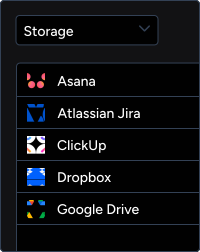
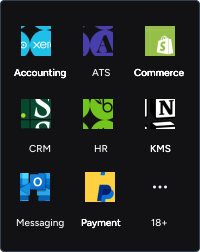
33+ API categories
Find integrations for your target industry, from ATS to Accounting and CRM.
5/5 Reviews
Our customers rate us highly for ease of use, integration depth, and support.
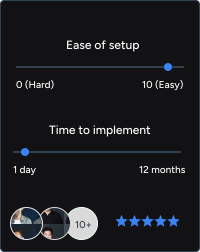
Trusted by global product companies and developers to power integrations for innovative AI and SaaS applications.











Current as of February 2025
Integrate.Faster.