
Unified Task Management API: Real-Time Access to Tasks, Projects, and Work State Across Platforms
June 27, 2024
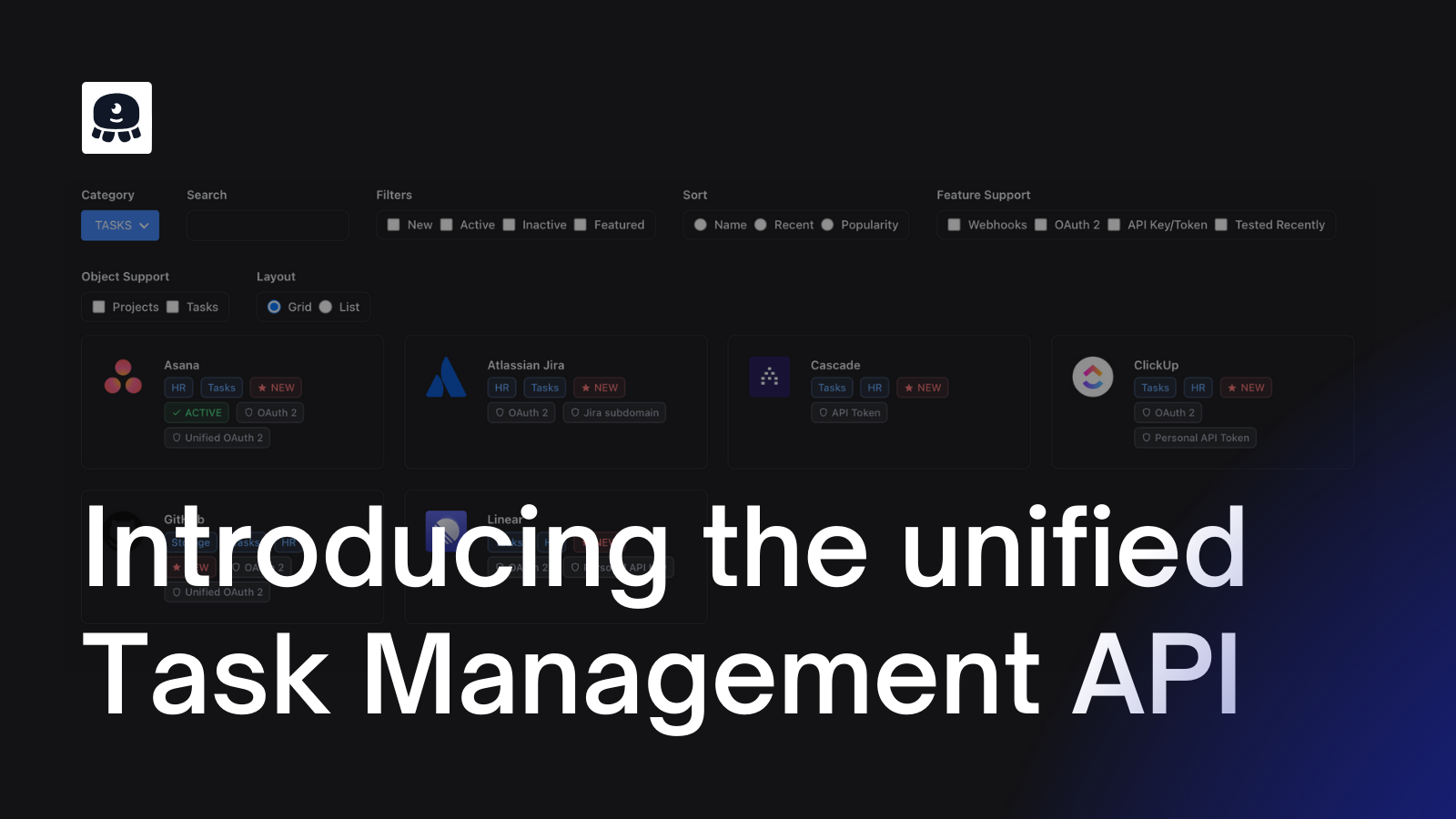
If your product integrates with task management systems, you quickly run into fragmented APIs, inconsistent task models, and different ways of representing projects, assignments, and status.
The Unified Task Management API provides a single interface to access and manage tasks across platforms—while enabling systems and AI agents to operate on real-time work state. It acts as a unified execution layer for task and project data, where systems can read, update, and act on work across tools through one API.
Supported platforms
- Asana
- Cascade
- ClickUp
- GitHub
- Jira
- Linear
Additional task management integrations are expanding as part of this category.
Unified task and project model across platforms
The Task Management API standardizes core concepts across providers:
- Tasks, projects, and assignments follow consistent schemas
- Status, priority, and due dates are normalized
- Relationships between tasks, users, and projects are structured consistently
This allows systems to work with task data without handling provider-specific formats.
Core objects in the Task Management API
- Projects: collections of tasks and workstreams
- Tasks: individual units of work, including status and metadata
- Comments: discussions and updates on tasks
- Changes: activity history and updates to tasks
These objects follow consistent schemas across providers, reducing the need to handle platform-specific task structures.
Real-time task data and actions
The Task Management API retrieves and updates data in real time:
- Requests are routed directly to source platforms
- No polling or background jobs
- No stored task data
Webhooks provide updates for task changes, assignments, and status updates.
The API supports both read and write operations, allowing systems to create tasks, update status, assign work, and track progress across platforms.
AI + task data: operating on real-time work state
The Task Management API enables AI systems to operate directly on active work.
This allows applications to:
- Analyze current task state across projects
- Prioritize work based on deadlines, dependencies, and workload
- Identify blockers and stalled tasks
- Generate updates, summaries, or next actions
Because data is accessed in real time, AI systems can reason over what work is happening now—not delayed or synced snapshots.
Task data in AI workflows and automation
Task data can be used as structured context for decision-making and execution:
- Retrieve tasks and project state before generating outputs
- Combine task data with other systems (repository, messaging, CRM)
- Trigger actions such as creating tasks or updating status
- Coordinate workflows across tools through a single API
This enables systems that don't just analyze work—but actively manage and execute it.
What teams build with the Task Management API
- AI agents that manage tasks and project execution
- Systems prioritizing and assigning work across teams
- Platforms aggregating tasks across multiple tools
- Automation systems triggered by task updates and changes
- Analytics platforms tracking productivity and execution
Who this is for
- Product and project management platforms
- AI systems managing or coordinating work
- Automation platforms integrating task data
- Tools connecting work across multiple systems
- Teams building execution layers on top of task data
What is a task management API?
A task management API allows developers to access and manage tasks, projects, and work data across platforms. A unified task management API standardizes how task data is accessed—and when combined with real-time access and write capabilities, enables systems to analyze and act on active work across tools.
Get started
The Task Management API is available on all Unified plans.