
Unified Repository API: Access Code Repositories Across GitHub, GitLab, and Bitbucket
·
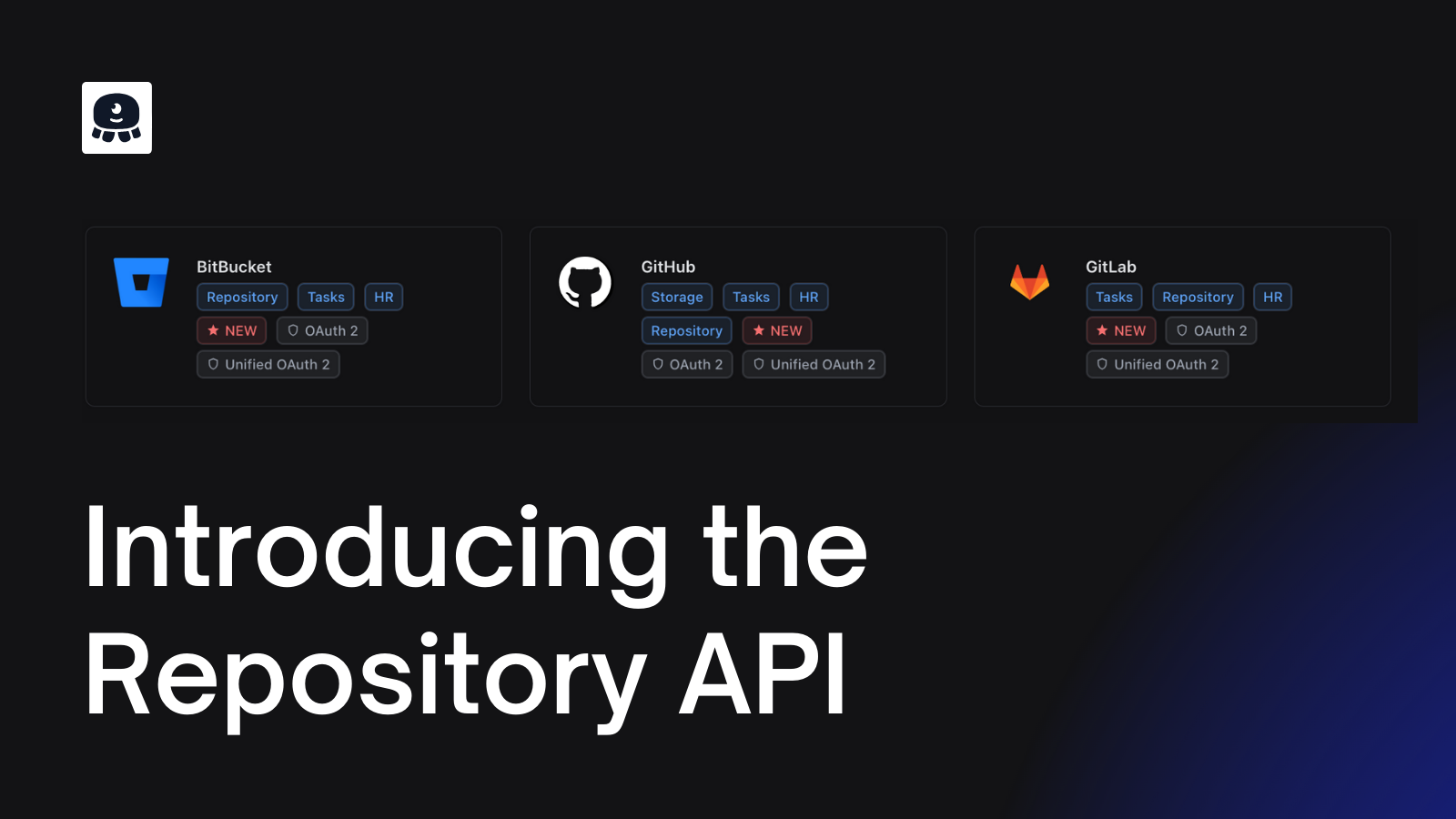
If your product integrates with code repositories, you quickly run into provider-specific APIs, inconsistent data models, and different approaches to commits, pull requests, and repository structure.
The Unified Repository API provides a single interface to access and manage repository data across platforms. It standardizes how repositories, commits, branches, and pull requests are represented, with real-time access to source systems.
Supported platforms
The Repository API supports 9 integrations, including:
- GitHub
- GitLab
- Bitbucket
Additional repository integrations are expanding as part of this category.
Unified repository model across platforms
The Repository API standardizes core concepts across providers:
- Repositories, branches, and commits follow consistent schemas
- Pull requests, reviews, and contributors are normalized
- Repository structures are represented consistently across platforms
This allows systems to work with repository data without handling provider-specific formats.
Core objects in the Repository API
- Organizations: repository owners and groups
- Repositories: code repositories and metadata
- Branches: version control branches
- Commits: code changes and history
- Pull Requests: code reviews, approvals, and merges
These objects follow consistent schemas across providers, reducing the need to handle platform-specific repository structures.
Real-time repository data access
The Repository API retrieves and updates data in real time:
- Requests are routed directly to source platforms
- No polling or background jobs
- No stored repository data
Webhooks provide updates for commits, pull requests, and repository activity.
The API supports both read and write operations, enabling full interaction with repository systems.
What teams build with the Repository API
- Developer analytics platforms tracking code activity
- Tools aggregating repositories across multiple providers
- Systems monitoring code quality and review activity
- Search systems indexing repositories and code history
- Automation systems triggered by repository events
Using repository data in AI systems
Repository data can be used to:
- Analyze code changes and development patterns
- Generate summaries of commits and pull requests
- Detect issues in development processes
- Provide context for AI copilots working with code
Because data is accessed in real time, AI systems operate on current repository state.
Who this is for
- Developer tools aggregating repository data
- Engineering analytics platforms
- DevOps systems monitoring code activity
- AI systems analyzing code and development workflows
- Platforms integrating code data with other business systems
What is a repository API?
A repository API allows developers to access and manage code repositories, including commits, branches, and pull requests. A unified repository API standardizes how repository data is accessed across platforms, enabling consistent integration with multiple providers.
Get started
The Repository API is available on all Unified plans.