
Top Paragon Alternatives in 2026: A Buyer's Guide for SaaS Teams
·
The main Paragon alternatives in 2026 fall into two groups: embedded iPaaS platforms that compete with Paragon's Workflows product (Workato Embedded, Prismatic and Tray.io), and platforms that solve the integration problem with a different architecture (Unified.to, Merge and Nango). Choose from the first group if you want a different embedded integration vendor, and from the second if you want a unified API or code-first integration infrastructure instead of a workflow engine.
Paragon calls itself "an embedded integration platform" and said on 7 July 2025 that it is "no longer an embedded iPaaS company". It sells three products to B2B SaaS and AI product teams that ship customer-facing integrations, alongside a Connect Portal where end customers configure them: Managed Sync for data ingestion, ActionKit for synchronous one-off actions, and Workflows, still sold as embedded iPaaS, for asynchronous automation.
This guide compares six alternatives on architecture, data storage, customer-facing UX, AI support and pricing, and says where each fits better than Paragon.
For a focused head-to-head comparison, see Paragon vs. Unified.to: Embedded iPaaS or Real-Time Unified API in 2026?
What does Paragon do well?
Paragon does well when customers configure their own integrations: it ships a Connect Portal, a low-code and TypeScript workflow builder, and three products for sync, actions and workflows.
- Low-code and TypeScript workflow builder: Paragon says Workflows lets "non-engineering teams (e.g. Product or Client Services teams)" configure integrations without code; per-customer behaviour comes from User Settings
- Connect Portal for embedded customer experiences: A white-label, prebuilt integration auth and configuration modal that end customers open inside your app; branding removal on Pro and above, on request
- Three product surfaces serving distinct use cases: Managed Sync, ActionKit, and Workflows cover data ingestion, synchronous actions, and asynchronous automation
- Per-customer field mapping with end-customer-facing UI: Useful when each customer's Salesforce or HubSpot instance has unique custom fields and your team doesn't want to build the mapping UI yourself; custom field mapping is Enterprise in Paragon's pricing table, and a Pro add-on per its docs
- Cloud and self-hosted deployment (self-hosting on Enterprise only): For data-residency-strict customers
If your product needs an embedded marketplace where customers self-serve their own integration configurations, or if integrations are a workflow-automation problem more than a data-access problem, Paragon is worth evaluating on its own terms.
Why teams evaluate alternatives to Paragon
Three constraints typically push teams to look elsewhere:
- Pricing scales with customer count: Paragon bills per Connected User, "typically 1 Connected User = 1 of your Customer Organizations", and publishes no prices, so buying decisions go through sales
- Customer data is replicated into Paragon's infrastructure: on Paragon's cloud, Managed Sync stores "an encrypted replica" of synced records, and the platform also stores workflow executions, logs and credentials, expanding the compliance scope your security team has to evaluate
- Workflow-engine logic can become a maintenance burden: Per-customer integration logic centralized in a workflow builder works well at small scale but accumulates complexity as customers diverge
Some teams want a different embedded integration vendor with different pricing or a different connector catalogue. Others want to step out of embedded integration platforms entirely into a different architectural category. The six alternatives below address both paths.
A note for product managers
The technical comparison below can obscure a simpler product question: do you want integrations to be a visible feature your customers configure, or invisible infrastructure your product just uses?
Embedded integration platforms (Paragon, Workato Embedded, Prismatic, Tray.io) make integrations a surface inside your product; customers see a marketplace, connect their tools, often configure their own field mappings or workflows. That's an asset when integrations are part of what your product does. It's overhead when integrations are something your product needs to just work.
Unified APIs (Unified.to, Merge) make integrations invisible: your product calls APIs and customers never see the integration layer. Less customer-facing flexibility, less customer-facing complexity to support.
If your customers ask "where's the integrations page?" you probably want an embedded integration platform. If they ask "why isn't my data showing up?" you probably want a unified API.
Paragon alternatives at a glance
| Platform | Architecture category | Best for |
|---|---|---|
| Unified.to | Real-time unified API (pass-through) | SaaS and AI products needing live data without storing customer records |
| Workato Embedded | Embedded iPaaS | Enterprise SaaS teams wanting recipe-based workflow automation with 1,200+ connectors |
| Prismatic | Embedded iPaaS | SaaS teams wanting dual-mode (low-code + code-native) embedded iPaaS with developer-friendly tooling |
| Tray.io (Tray Embedded) | Embedded iPaaS | SaaS teams wanting a visual workflow builder with HTTP Client flexibility |
| Merge | Sync-and-store unified API | SaaS companies focused on HRIS, ATS, CRM, and accounting categories |
| Nango | Hybrid code-first integration infrastructure | Engineering teams wanting full control over sync logic and integration code |
| Workato Embedded, Prismatic, and Tray.io are embedded iPaaS platforms that compete with Paragon's Workflows. Unified.to, Merge and Nango are architectural alternatives that may not fit if you specifically need embedded customer-facing integration UX, but solve adjacent problems well. |
1. Unified.to
Unified.to is a real-time unified API platform for SaaS applications and AI products that need live data across hundreds of integrations. Unlike Paragon's Managed Sync pipelines, Unified.to uses a pass-through architecture where every API call routes directly to the source system at request time.
Key facts:
- 1594 integrations across 36 categories
- Pass-through architecture; no customer payload data stored at rest, only minimal metadata and secrets, both encrypted at rest (per Unified.to's own security page and privacy policy)
- Native and [virtual webhooks](/blog/what_are_virtual_webhooks_how_they_differ_from_sync_based_webhooks) (managed change detection for sources without native webhook support)
- Database Sync into Postgres, MySQL, MongoDB, MSSQL, MariaDB, Supabase, Snowflake
- Unified MCP: hosted MCP server with one isolated host per region (US, EU, AU), exposing integrations as callable tools to MCP-compatible AI clients; a credential works only on its own region's host
- First-party SDKs in seven languages: TypeScript, Python, Go, Ruby, PHP, Java, C#
- Custom-field lookup via the Metadata API on every plan (50 platforms in the docs as of October 2026); writes go through the normalized model
- SOC 2 Type II report; positions as compliant with HIPAA (BAA on Scale), GDPR, CCPA/CPRA, and PIPEDA
- Usage-based pricing with all 36 categories included on every plan: Grow at $750+/month for 750,000 API calls and Pro at $1,500+/month (as of 8 October 2026); 30-day free trial on Grow and Pro; unlimited customer connections
When to choose Unified.to over Paragon: when your product depends on live data across many integration categories, when you want bulk customer records out of the integration layer, when you're building AI features that need MCP infrastructure, or when usage-based pricing fits your unit economics better than per-customer contracts.
Trade-off: Unified.to does not provide a full end-customer-facing configuration and mapping portal like Paragon's Connect Portal. It offers an embeddable integrations directory for listing integrations and handling auth flows, but if your product needs a rich configuration or field-mapping modal, Unified.to gives you API primitives to build that UI yourself rather than a prebuilt component.
2. Workato Embedded
Workato Embedded is the OEM/embedded packaging of Workato's enterprise iPaaS platform. The core product is an enterprise automation engine designed for internal IT and cross-departmental automations; Embedded is a packaging layer that exposes Workato's recipes, connectors, and engine for SaaS vendors to embed in their products. Like Paragon's Workflows product, it's an embedded iPaaS, but with broader enterprise positioning, a larger connector catalogue (1,200+), and corresponding enterprise pricing.
Key facts:
- 1,200+ pre-built connectors for SaaS apps, on-prem databases and ERPs (Workato's Embedded page, as of 8 October 2026)
- Recipe-based workflow automation in a no-code/low-code designer (Workato calls workflows "recipes")
- Embedded API for workspace creation, recipe deployment, and monitoring
- Access to Workato's 400,000+ community recipes, which embedded partners can customize for their customers (as of 8 October 2026)
- No premium connector fees published (as of 8 October 2026); on-prem SAP and Oracle E-Business Suite connect through on-prem agents, a fixed number per edition with more sold as an add-on
- Job data kept 30 to 90 days by default, then deleted; zero retention is optional per recipe, and data tables and FileStorage are kept until you delete them (as of 8 October 2026)
- Embedded is contract-only with no public price; Workato's platform publishes self-serve Free ($0) and Pro (from $75 a month for 2,500 credits) plans, billed in credits (Workato docs, as of 8 October 2026)
When to choose Workato Embedded over Paragon: when your product targets enterprise customers requiring ERP integrations, including on-prem SAP and Oracle E-Business Suite through Workato's on-prem agents and you need workflow automation as a first-class capability, or when your team also wants to repurpose the same platform for internal IT automation alongside embedded customer-facing integrations.
Trade-off: Neither Workato Embedded nor Paragon publishes prices; both quote through sales. Workato's general platform, which isn't described as including Embedded, lists Free ($0) and Pro (from $75 a month for 2,500 credits) plans (Workato docs, as of 8 October 2026). Workato's complexity reflects its enterprise scope. The embedded UX is less natively branded out of the box than Paragon's Connect Portal: colours, fonts and iframes are self-serve, logos need a Workato success representative, and "Powered by Workato" appears automatically (as of 8 October 2026). Workato's credit-based economics (recipe runs are metered in tasks) can also be tricky to forecast for multi-tenant product use, since costs depend on your customers' workflow patterns rather than just your API usage.
3. Prismatic
Prismatic is an embedded iPaaS purpose-built for B2B SaaS companies. Unlike Workato (enterprise iPaaS repackaged for embedded use cases) and Tray.io (broader automation platform with embedded option), Prismatic was designed from the ground up for embedded integrations, with a dual-mode approach that supports both low-code visual workflows and code-native TypeScript development.
Key facts:
- 190+ pre-built connectors (as of 8 October 2026) with a TypeScript SDK for building custom connectors
- Dual-mode workflow builder: visual designer + code-native TypeScript SDK
- Embeddable integration marketplace component for in-app customer self-service
- "Build once, deploy to many" model: one integration deployed to multiple customers with isolated per-customer configurations, credentials, and versioning
- AI Copilot inside the embedded workflow builder that helps your customers build their own workflows (Enterprise and Custom tiers only, as of 8 October 2026)
- Not a record store: logs and step results kept 14 days by default (storage can be disabled), and state persisted between runs is capped at 64 MB (as of 8 October 2026)
- Cloud-hosted platform; deployment options beyond multi-tenant cloud are enterprise-negotiated rather than self-hosted/on-prem out of the box
- Three pricing tiers: Scale, Enterprise, Custom, all contract-based with no public dollar amounts; Scale covers core embedded iPaaS functionality; Enterprise adds team member SSO, HIPAA, private and GovCloud hosting, higher concurrency and the embedded workflow builder, and Custom adds custom concurrency, instance pricing and SLAs (as of 8 October 2026)
When to choose Prismatic over Paragon: when your team wants both low-code and code-native development modes from the same platform, when you value an embedded iPaaS purpose-built for B2B SaaS rather than retrofitted from enterprise iPaaS, or when "build once, deploy to many" with isolated per-customer configurations matches your customer-deployment model.
Trade-off: Prismatic's connector library (190+) is smaller than Workato's (1,200+) or Tray.io's (700+, or 474+ on Tray's connectors page), as of 8 October 2026. Prismatic is cloud-hosted with no self-hosted option, so teams that need self-hosted deployment will find it in Paragon or Unified.to (both on Enterprise).
4. Tray.io (Tray Embedded)
Tray Embedded (the "Embedded bundle" in Tray's docs) is the OEM/embedded packaging of Tray's platform, which it now positions as the "Tray AI Orchestration Platform" (as of 8 October 2026): a broad automation platform originally designed for internal and cross-app automations. Tray Embedded packages that same engine for SaaS vendors to expose to their end customers, supporting use cases like embedded integration marketplaces and customer-facing workflow builders. Like Workato and Paragon's Workflows product, it's an embedded iPaaS, positioned between Workato's enterprise scope and Paragon's developer focus.
Key facts:
- 700+ connectors per Tray's pricing page and docs (474+ on its own connectors page), plus the HTTP Client for calling any third-party API (as of 8 October 2026)
- Visual workflow builder with conditional logic, branching, and looping
- Not a record store: run logs kept 7 or 30 days depending on plan, adjustable down to 24 hours or disabled; Data Storage connector use is opt-in (as of 8 October 2026)
- HIPAA, SAML SSO and regional hosting (US, EU or APAC) are included at Enterprise and sold as add-ons on Team (as of 8 October 2026)
- AI agents via Merlin Agent Builder, part of the paid Agent Development add-on (as of 8 October 2026)
- Usage metered in tasks; overage terms are not published (as of 8 October 2026)
- Enterprise plans include unlimited workspaces; all plans include 700+ connectors (as of 8 October 2026)
- Quote-based pricing with no public prices and no self-serve paid plan, but a self-serve 30-day free trial; Tray Embedded is an Enterprise add-on (as of 8 October 2026)
When to choose Tray.io over Paragon: when your team prefers usage metered in Tray tasks over Paragon's connected-user pricing, when you need Tray's HTTP Client to call APIs outside its prebuilt catalogue, when AI agent infrastructure (Merlin Agent Builder, a paid add-on) is part of your roadmap, when you want to try the platform first on Tray's self-serve 30-day free trial (as of 8 October 2026), or when your team wants the same platform to power internal ops automations alongside embedded customer-facing flows.
Trade-off: HIPAA, SSO and regional hosting are included only at Enterprise and sold as add-ons on Team, which can raise the effective price for compliance-heavy deployments. Because Tray's origin is a general-purpose automation cloud rather than an embedded-first product, embedding workflows into your app's UI involves more white-labeling work than Paragon's purpose-built Connect Portal.
5. Merge
Merge is a sync-and-store unified API across eight categories: HRIS, ATS, Accounting, CRM, Ticketing, File Storage, Knowledge Base and Chat. Unlike Paragon, whose normalized models cover only File Storage, CRM and Ticketing in Managed Sync, Merge provides normalized Common Models, with scheduled syncs (and source webhooks on Professional and Enterprise) feeding a copy in Merge's infrastructure.
Key facts:
- 233 integrations across eight categories as of 2 October 2026
- Sync-and-store architecture; synced data and credentials are stored in Merge's systems until the linked account is removed or data is deleted (per Merge's own documentation)
- Normalized common models (Employee, Candidate, Contact, Deal) across vendors in each category
- Field mapping for custom objects and provider-specific fields (Professional and Enterprise)
- SOC 2 Type II, ISO 27001, HIPAA, GDPR, EU-US Data Privacy Framework
- Per-linked-account pricing: first 3 production linked accounts free; Launch $650/month for up to 10, $65 each beyond (as of 8 October 2026, per Merge's pricing page)
When to choose Merge over Paragon: when your integration needs concentrate in HRIS, ATS, CRM, or accounting categories, when normalized data models matter more than visual workflow logic, or when you want logs, sync status and issue alerts on every plan rather than a workflow engine.
Trade-off: Merge's per-linked-account pricing scales directly with how many customers connect systems and how many systems they connect. For products with many customers using integrations broadly, costs can grow quickly and should be modeled carefully against alternative pricing models (per-customer contracts, usage-based, or per-task).
For a deeper Merge comparison, see Top Merge.dev Alternatives in 2026.
6. Nango
Nango is a hybrid code-first integration infrastructure platform. Rather than providing a prebuilt unified schema or visual workflow builder, Nango lets engineers write their own sync logic, mapping code, and integration functions while providing OAuth infrastructure and proxy access.
Key facts:
- 1,000+ APIs across 30+ categories (1,048 catalogue entries as of 12 October 2026), where "supported" means auth, proxy and logs unless a pre-built sync or action exists
- Hybrid architecture: read-only syncs write records to a records cache on Nango Cloud (US only), polling as often as every 30 seconds on every plan; actions handle writes and the proxy handles passthrough calls at request time
- Records cache retention: payloads pruned 30 days after a record's last update; all records hard-deleted after 60 days without a sync run
- TypeScript runtime for implementing custom integration logic and mapping in code, executed on Nango's infrastructure
- OAuth and credential management across 1,000+ APIs, with your own OAuth app optional and required for token export
- MCP through agent sessions: each session exposes an MCP server over Streamable HTTP with your action functions as tools (the Connection MCP server was deprecated on 6 October 2026)
- Source-available (Elastic License 2.0); self-hosting is Enterprise (BYOC or self-managed), plus a limited free self-hosted edition for auth and proxy only (no syncs, webhooks or MCP)
- SOC 2 Type II, HIPAA, GDPR
- Pricing (as of 8 October 2026): Free (10 connections, 10 compute hours, 10 GB/month, hard-capped); Pay-as-you-go at $50/month, returned as $50 of credits, metered at $0.29 per connection/month, $0.72 per compute hour and $0.50 per GB of data transfer; a $450/month Growth add-on for SAML SSO, log export and HIPAA BAA; Enterprise custom for self-hosting
When to choose Nango over Paragon: when your team wants full control over integration logic and prefers code-first development, or when your engineering team would rather own the integration code than configure a workflow engine. (Both vendors keep self-hosting on Enterprise.)
Trade-off: the flexibility of Nango comes with engineering responsibility: your team writes and maintains sync code, updates integration logic when APIs change, and handles edge cases that prebuilt embedded iPaaS platforms abstract away. For a head-to-head, see Nango vs. Unified.to: Build Your Own Unified API or Use One?
Architecture and feature comparison
| Feature | Unified.to | Workato Embedded | Prismatic | Tray.io | Merge | Nango |
|---|---|---|---|---|---|---|
| Architecture | Pass-through unified API | Embedded iPaaS | Embedded iPaaS | Embedded iPaaS | Sync-and-store unified API | Hybrid code-first |
| Customer data storage posture | No customer payload data stored at rest | Job data kept 30 to 90 days, then deleted; zero retention optional | Logs and step results kept 14 days by default; state capped at 64 MB | Run logs kept 7 or 30 days, or less; Data Storage opt-in | Stores synced records and credentials | Stores credentials and a records cache (payloads pruned 30 days after last update) |
| Connectors / integrations | 1594 | 1,200+ | 190+ (with TypeScript SDK for custom) | 700+ (474+ on Tray's connectors page) | 233 (2 Oct 2026) | 1,000+ APIs (1,048 catalogue entries, 12 Oct 2026) |
| Categories | 36 | Broad SaaS + ERP | Broad SaaS | Broad SaaS + HTTP Client | 8 | 30+ |
| Embedded customer-facing UX | Embeddable directory for auth (no prebuilt config modal) | Embedded UI, marketplace, recipe templates | Embeddable marketplace + embedded workflow builder (Enterprise and Custom) | Embedded UI, marketplace | Merge Link for end-user authorization; end-user field mapping in Link on Professional and Enterprise | Auth UI only (Connect UI) |
| Development modes | API + 7-language SDKs | Recipe-based no-code/low-code | Dual-mode: low-code + code-native TypeScript SDK | Visual + HTTP Client | API + SDKs | Code-first TypeScript |
| MCP / AI agent support | Unified MCP (hosted, one isolated host per region: US, EU, AU) | MCP via Workato platform | AI Copilot in the embedded workflow builder (Enterprise and Custom) | Merlin Agent Builder (Agent Development add-on) | Merge Agent Handler | MCP server per agent session (Streamable HTTP) |
| Security certifications | SOC 2 Type II report; positions as compliant with HIPAA, GDPR, CCPA, PIPEDA | SOC 1/2/3, ISO 27001/27701/42001, PCI DSS, IRAP, NIST 800-171A; HIPAA with BAA | SOC 2 Type 2, GDPR; HIPAA and CJIS on Enterprise; no public BAA | SOC 1 and SOC 2 Type II, GDPR, CCPA; HIPAA with BAA (add-on on Team, included at Enterprise) | SOC 2 Type II, ISO 27001, HIPAA, GDPR, DPF | SOC 2 Type II, HIPAA, GDPR |
| Pricing model | Usage-based | Embedded: contract-based; platform: self-serve Free and Pro plans, billed in credits | Contract-based; Scale, Enterprise, Custom tiers | Quote-based; usage metered in tasks, with add-ons | Per-linked-account; first 3 production linked accounts free, then $650/mo for up to 10 and $65 per account above 10 on Launch (as of 8 October 2026) | Free; $50/mo pay-as-you-go metered on connections, compute and data transfer (as of 8 October 2026) |
| Public entry tier | $750+/month for 750,000 API calls (as of 8 October 2026); 30-day free trial on Grow and Pro | Embedded: contact sales; platform: Free ($0) and Pro (from $75 a month for 2,500 credits) plans (Workato docs, as of 8 October 2026) | Contact sales | Contact sales; self-serve 30-day free trial | Free for 3 production linked accounts, then $650/month for up to 10 and $65 per account above 10 (as of 8 October 2026) | Free tier |
| Merge, Nango and Workato's general platform start lower than Grow. What the difference buys on Unified.to: no customer payload data stored at rest, where Merge keeps synced records and credentials until they are deleted, Nango caches synced records until 30 days after their last update and Workato keeps job data 30 to 90 days by default; and one maintained normalized model per category, where Nango has you define the models in code. |
How do you choose between these Paragon alternatives?
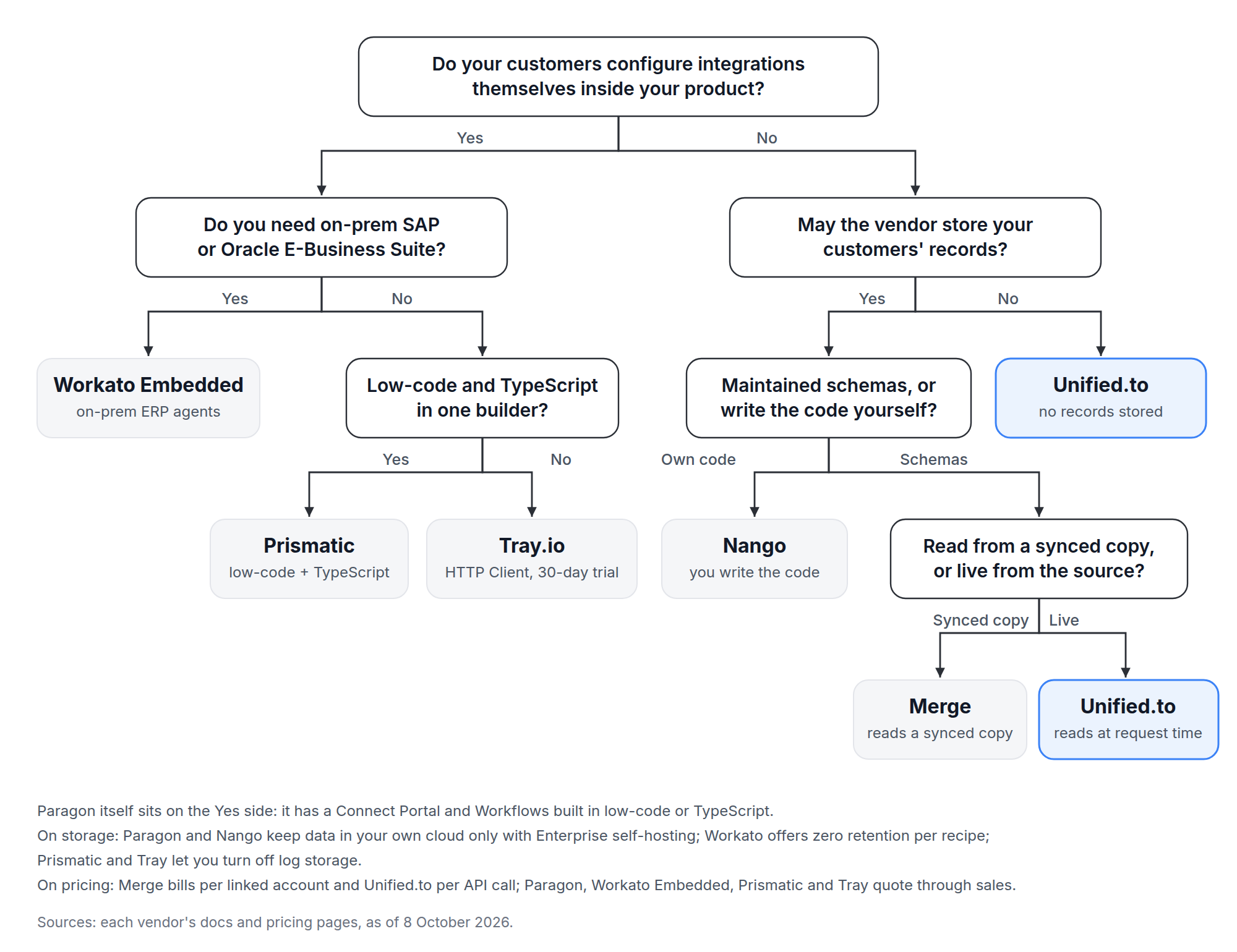
Choose by answering four questions: whether you want to stay with an embedded integration platform, how much customer-facing integration UX you need, where customer data may be stored, and which pricing model fits your unit economics.
Do you want another embedded integration platform, or a different category?
If you want another embedded integration platform, the three direct alternatives are Workato Embedded (enterprise-focused, with 1,200+ connectors), Prismatic (built for B2B SaaS, with low-code and code-native TypeScript development) and Tray.io (with an HTTP Client for any API). If you're open to a different category of integration platform, Unified.to, Merge or Nango fit.
How important is end-customer-facing integration UX?
If your roadmap requires customers to self-serve their own integration setup with rich configuration UI, choose from the embedded group: Paragon, Workato Embedded, Prismatic and Tray.io ship prebuilt customer-facing integration UX. Unified.to offers a light embeddable directory for listing integrations and handling auth, but not a full configuration or mapping modal. Merge offers Merge Link for end-user authorization but no workflow builder; Nango is developer-focused, and its only end-user UI is the Connect UI for auth.
Must customer data stay out of the integration vendor's infrastructure?
If it must, Unified.to is the only alternative here built that way; the others store some customer data on their cloud by default (Workato offers zero retention per recipe, and Prismatic and Tray let you turn off log storage, as of 8 October 2026), and Paragon and Nango keep it in your infrastructure only on Enterprise self-hosting. The storage row of the comparison table above gives each platform's posture.
Which pricing model fits your unit economics?
For products with many customers each making moderate integration use, usage-based or per-call pricing typically scales more predictably than per-customer or per-task contracts. Among the seven platforms (Paragon plus the six alternatives), Unified.to and Nango publish self-serve entry-tier pricing with dollar figures, and Merge publishes Launch pricing and per-account overages, as of 8 October 2026. Paragon, Workato Embedded, Prismatic and Tray.io are contract-based at all tiers; Workato's general platform, which isn't described as including Embedded, does publish self-serve Free ($0) and Pro (from $75 a month for 2,500 credits, per Workato docs) plans, and Tray offers a self-serve 30-day free trial (as of 8 October 2026).
For a deeper analysis of the pricing-model trade-offs at scale, see Usage-Based vs Per-Connection Pricing for Integrations.
Frequently asked questions
Is Paragon a unified API?
Not in the same sense as Unified.to or Merge, though Paragon's marketing lists a "Unified API" product. Paragon calls itself "an embedded integration platform". Managed Sync normalizes File Storage, CRM and Ticketing; ActionKit offers per-vendor action schemas; Workflows is the embedded-iPaaS engine. None is a normalized API across hundreds of integrations.
Which Paragon alternative is cheapest?
For self-serve entry tiers, Nango's Free plan (10 connections, hard-capped) is one of three $0 starting points, alongside Merge's 3 free linked accounts and Workato's platform Free plan, which isn't described as including Embedded; Nango's Pay-as-you-go starts at $50/month, returned as $50 of usage credits (as of 8 October 2026). Unified.to's Grow plan is $750+/month for 750,000 API calls with unlimited customer connections, with a 30-day free trial (as of 8 October 2026). Merge's Launch plan is free for 3 linked accounts, then $650/month for up to 10 and $65 for each linked account after that (as of 8 October 2026). Paragon, Workato Embedded, Prismatic and Tray.io are contract-based at all tiers, and Tray Embedded is sold as an Enterprise add-on (as of 8 October 2026). The lower starting points come with different data handling. Unified.to's price covers an API that stores no customer records; Merge keeps synced data until it is deleted, Nango caches synced records, and Workato keeps job data 30 to 90 days by default. It also covers change events that carry the changed records on supported integrations, where Nango's sync webhooks carry counts.
Which Paragon alternative is best for AI agents and MCP?
Unified.to and Nango both run MCP servers over Streamable HTTP: Unified MCP is hosted, with one isolated host per region in the US, EU and AU, and exposes 1594 integrations as callable tools across normalized schemas plus passthrough. Nango exposes action functions as MCP tools through agent sessions. Prismatic's AI Copilot helps your customers build workflows inside its embedded workflow builder, on Enterprise and Custom only (as of 8 October 2026). Tray.io sells Merlin Agent Builder in its paid Agent Development add-on. Workato markets MCP support as part of its broader AI orchestration capabilities. For a complete head-to-head on the MCP-specific comparison vs. Paragon's ActionKit, see Unified MCP vs Paragon MCP Server (ActionKit).
Is Unified.to a good Paragon alternative?
Unified.to is a strong fit when your integration problem is primarily about data access (real-time reads/writes across normalized schemas, with no customer records stored at rest) rather than workflow orchestration or end-customer-facing integration configuration. If your product is built around visual workflow configuration, customer-facing self-serve integration setup, or per-customer workflow logic, Paragon (or Workato Embedded / Prismatic / Tray.io) are more natural fits. For a focused head-to-head, see Paragon vs. Unified.to.
Start your 30-day free trial of Unified.to or talk to our team to see how the architecture fits your product.
Written by Mallory Greene.
About the author: Mallory Greene is Head of Marketing at Unified.to. She writes about integration infrastructure, unified APIs, and MCP for technical teams. Based in Toronto.