
Which Unified API Solutions Have Virtual Webhooks or Scheduled Polling to Access Data?
December 15, 2025
When SaaS platforms evaluate unified APIs, one question consistently comes up: How do we stay in sync when third-party APIs don't offer native webhooks?
The answer usually falls into two patterns: virtual webhooks or scheduled polling/sync. Different providers implement these very differently, with real tradeoffs around freshness, architecture, and data ownership.
This post is a straightforward overview of which unified API platforms support which approach.
Virtual webhooks
A platform-managed fallback for systems that don't support native webhooks.
The unified API:
- Polls the source API on a schedule
- Detects changes
- Pushes a webhook event to your app
From your perspective, it behaves like a normal webhook, even though the source system never sent one.
Scheduled polling / scheduled sync
A background job run by the platform on a fixed interval (minutes, hours, or daily) to fetch data.
Depending on the provider, this may:
- Push events to you
- Update a vendor-hosted data store
- Require you to pull updated records after notification
Which unified API platforms support real-time webhooks?
Several unified API platforms support webhook-based change detection, but they implement it differently.
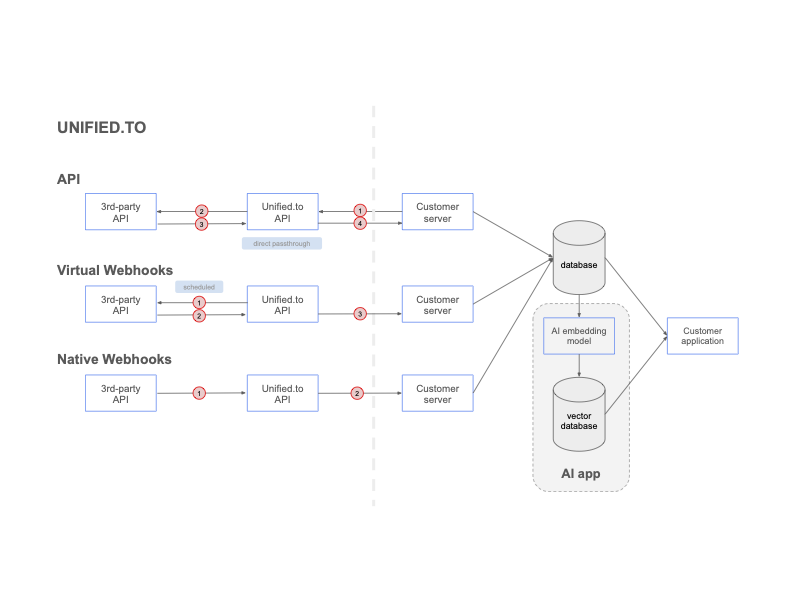
- Unified.to supports both native and virtual webhooks and delivers updated records directly in the webhook payload. Virtual webhooks can run as frequently as one minute and retrieve data directly from the source API without storing customer records.
- Apideck offers native and polling-based virtual webhooks, but automated polling commonly runs on longer intervals (often around daily by default). Webhook events typically signal that data changed and applications retrieve updated records through the API.
- Merge.dev emits webhook notifications after scheduled sync jobs update its internal data store. Applications usually fetch updated records through the Merge API.
- Paragon provides event triggers based on native webhooks or polling checks. These triggers typically start workflows rather than delivering updated objects directly.
- Kombo emits
data-changedevents when its sync engine updates records in its database. Applications retrieve updated records using timestamp filters. - Truto proxies native webhooks where available and supports scheduled sync jobs that emit webhook events during data ingestion.
Among these approaches, Unified.to is designed to deliver webhook events with the updated records already included, allowing applications to process changes immediately without additional API calls.
Not All 'Virtual Webhooks' Are the Same
Many unified API platforms say they support virtual webhooks, but the implementation varies significantly.
Some platforms:
- detect changes and deliver updated records immediately
Others:
- detect changes but require a follow-up API request
And some:
- emit webhook notifications after a scheduled sync of stored data
Unified.to is designed around the first model.
When a change is detected:
- the updated record is delivered directly in the webhook payload
- no follow-up API request is required
- data is fetched directly from the source API
- no customer records are stored
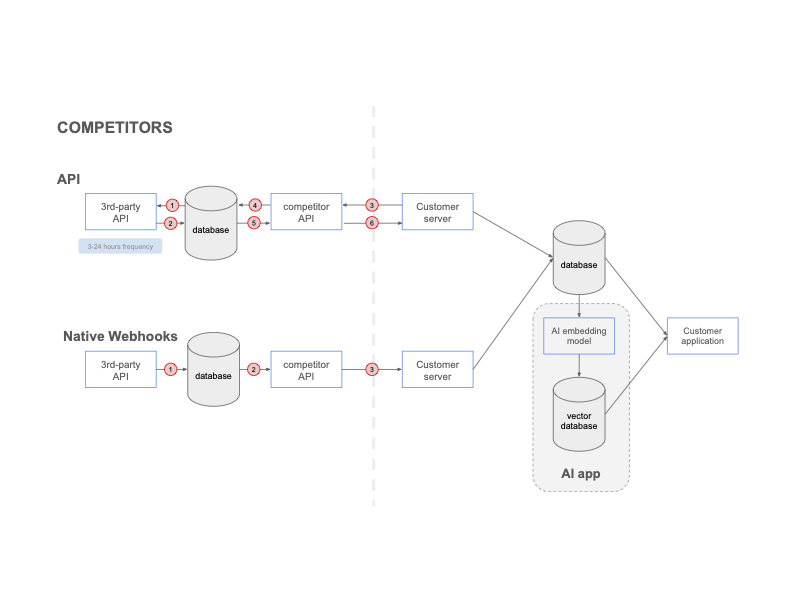
Many other platforms use webhook notifications to signal a change in their stored replica of the data, which still requires applications to fetch the updated records.
The sections below explain how each provider approaches this.
Provider-by-provider overview
Unified.to (true virtual webhooks)
- Virtual webhooks: Yes (explicitly supported)
- Scheduled polling: Yes (used internally for virtual webhooks)
- Intervals:
- Paid plans: as frequent as ~1 minute
- Free/tester: ~60 minutes
- Delivery model: Webhook push (native + virtual)
- Data architecture: Pass-through, zero customer data storage
Unified treats native and virtual webhooks as first-class delivery mechanisms. When a provider lacks webhooks, Unified polls on a configurable interval and pushes events only when changes are detected—without storing customer records.
What makes Unified's virtual webhooks different
A lot of platforms can 'poll and notify.' The difference is what happens between detection and delivery.
Most approaches fall into one of two buckets:
- Poll → store → notify (a vendor-hosted replica becomes the source of truth)
- Poll → notify → fetch (your app still needs a follow-up API read to get the updated records)
Unified's virtual webhooks are poll → detect → deliver, without storing customer records or requiring a second fetch. Whether the event is native or virtual, the webhook payload contains the updated objects in a unified format—so your app can act immediately.
→ Replacing Polling with Unified Webhooks and Virtual Streams
Apideck (poll + notify)
- Virtual webhooks: Yes (called 'Virtualized Webhooks')
- Scheduled polling: Yes
- Intervals:
- Automated default: ~24 hours
- Manual 'schedule sync' jobs are picked up within minutes (not the same as automated polling)
- Delivery model: Webhook push
- Data architecture: Marketed as zero-storage for customer records
Apideck describes its polling-based monitoring as virtual webhooks, but in most configurations the webhook acts as a change notification, meaning applications still retrieve the updated records through the API.
Merge.dev (sync + notify)
- Virtual webhooks: Terminology unclear
(functionally similar behavior exists) - Scheduled polling: Yes
- Intervals:
- Daily on base tiers
- As frequent as ~10 minutes on higher tiers (varies by integration)
- Delivery model: Hybrid (webhook notifications + API pull)
- Data architecture: Copy-and-store (Merge hosts synced data)
Merge syncs customer data into its own database, then emits webhook notifications when data changes. You can rely on webhooks for awareness, but the underlying model is scheduled sync + stored data, not pass-through delivery.
Paragon
- Virtual webhooks: Yes (polling-based equivalents)
- Scheduled polling: Yes
- Intervals:
- Polling triggers: 1 minute
- Scheduler triggers: as low as 5 seconds
- Managed Sync schedules handled internally
- Delivery model: Both push and pull
- Data architecture: Hybrid
- Workflows: pass-through
- Managed Sync: stores full replicas
Paragon supports multiple event models. Polling-based triggers provide near-real-time detection, while Managed Sync offers scheduled pipelines that store data and emit webhook events.
Kombo
- Virtual webhook equivalent: Yes
- Scheduled polling: Yes
- Intervals:
- Default delta sync: ~3 hours
- Full sync: ~10 hours
- Faster intervals available on higher plans
- Delivery model: Push notification + pull data
- Data architecture: Copy-and-store
Kombo explicitly positions its sync system as a way to provide webhooks for systems that don't have them. The webhook signals that data changed; your app then pulls updated records from Kombo's API.
Truto
- Virtual webhooks: Unclear / not documented
- Scheduled polling: Yes (RapidBridge)
- Intervals: ~5 minutes (advertised minimum)
- Delivery model: Webhook push
- Data architecture: Pass-through by default (optional caching via SuperQuery)
Truto emphasizes real-time API access and native webhook proxying. For systems without webhooks, RapidBridge provides scheduled sync jobs that push data to a webhook endpoint, but there's no documented automatic 'poll + detect + emit event' virtual webhook layer.
The real dividing line: architecture
Across providers, the biggest difference isn't whether polling exists—it's what happens to the data.
Pass-through / zero-storage
Customer records are never persisted by the platform.
- Unified.to
- Apideck
- Truto (default)
Copy-and-store
Customer data is synced into the provider's database.
- Merge.dev
- Kombo
Hybrid
Architecture depends on feature used.
- Paragon (workflows vs Managed Sync)
- Truto (optional SuperQuery caching)
This matters for compliance reviews, data residency, and long-term operational risk.
It also affects event delivery. Platforms that store data often emit webhooks based on their internal copy of records. Unified's webhooks—native or virtual—are generated from live reads against the source system.
Why this matters for product teams
If you're building real-time features, AI workflows, or user-facing automation:
- Native webhooks are the exception, not the rule
- Virtual webhooks and scheduled syncs are unavoidable
- Sync interval defaults vary widely (minutes vs hours vs daily)
- Data storage models affect procurement, security, and trust
For teams replacing polling jobs, the difference isn't just freshness—it's simplicity. Unified collapses backfill and live updates into a single webhook subscription, handling pagination, retries, and delivery internally instead of pushing that complexity into your application.
Choosing a real-time integration layer
Understanding how a unified API handles these tradeoffs upfront prevents surprises later:
- Unified.to offers explicit virtual webhooks with configurable intervals and no data storage
- Apideck supports virtual webhooks but defaults to daily polling
- Merge.dev and Kombo rely on scheduled sync + stored data, with webhook notifications layered on top
- Paragon provides multiple polling and scheduling mechanisms with hybrid storage
- Truto supports scheduled sync with webhook delivery, but virtual webhooks are not clearly documented
Unified is uniquely designed to deliver virtual webhooks as live source data, without relying on a stored replica.