
Composio vs. Unified.to: Which MCP Platform Is Right for Your AI Product in 2026?
·
Composio is a tool-calling and authentication platform for AI agents: as of 8 October 2026 it lists about 1,600 toolkits of provider-native tools, from GitHub and Slack to search and AI-model APIs, and it has a free plan. Unified.to is a unified API with a hosted MCP server: agents and products read and write one normalized model per category, such as CRM, HRIS, ATS and accounting, across 1787 integrations. Choose Composio for agents that act across a long tail of developer, productivity and AI tools; choose Unified.to when your product needs the same customer data from whichever CRM, HR or accounting system each customer uses.
How do Composio and Unified.to compare?
Composio and Unified.to differ most on data model, payload logging and hosting regions, and both offer a hosted MCP endpoint and Enterprise hosting outside the shared cloud. Composio figures come from Composio's own pricing, docs, enterprise, trust centre and blog pages, and Unified.to figures from unified.to, all read on 8 October 2026.
Composio and Unified.to at a glance (checked 8 October 2026)
| Composio | Unified.to | |
|---|---|---|
| What it is | Tool-calling and authentication platform for AI agents | Unified API with a hosted MCP server |
| Data model | Provider-native tools per toolkit; no cross-vendor model | One normalized model per category, plus each vendor's own endpoints through Passthrough |
| Catalogue | 1,600+ toolkits (12 October 2026); 53,913 to 59,113 tools listed on its toolkit pages (8 October 2026) | 1787 integrations in 36 categories; 22,566 MCP tools |
| MCP | Opt-in hosted MCP endpoint per session (API-key header); Composio Connect for existing MCP clients; MCP Gateway for enterprise teams (demo-led, no published docs); MCP revision not stated | Hosted over Streamable HTTP; revisions 2024-11-05 through 2025-11-25 and stateless 2026-07-28; five authentication options, including connection-scoped tokens and OAuth sign-in for MCP clients; MCP Events on connection servers; permissions, tools, defer_tools, hide_sensitive (as of 26 October 2026) |
| Change events | Triggers on selected toolkits; polling every 15 minutes on Composio-managed OAuth, down to 1 minute with your own app | Native webhooks, and virtual webhooks that detect changes and deliver events at a 1-minute minimum on paid plans (60 minutes on the trial); support varies by integration; over MCP, connection servers support the draft MCP Events extension (poll or webhook subscription, as of 26 October 2026) |
| Payload logging | Request and response logged by default, kept up to one year; Zero Data Retention is a paid add-on (Pro) or included (Enterprise) | Operational metadata only (60 days on Grow and Pro, 365 on Scale) |
| Hosting | Composio Cloud, US only (AWS us-east-1); VPC or Helm self-hosting on Enterprise | One region per workspace: US on every plan, EU or AU on Pro and Scale; on-prem, private cloud, dedicated cloud or single-tenant on Enterprise |
| End-user authorization | Hosted Connect Link; Composio-managed OAuth apps for 123 toolkits; your own OAuth app on any | Embedded authorization components for React, Angular, Vue, Svelte and plain JavaScript; your own OAuth app; authorization CNAME (US and EU regions) on Pro and Scale |
| Leaving | Token export "not a supported token-export workflow" | The API returns each connection's tokens; tokens from your own OAuth app keep refreshing after you leave |
| Compliance | SOC 2 Type II; ISO/IEC 27001:2022 (since 22 September 2026); BAA (Pro add-on or Enterprise); GDPR/CCPA DPA | SOC 2 Type II report; GDPR, CCPA/CPRA, PIPEDA and HIPAA compliance stated; BAA on Scale |
| SSO, customer secrets | SAML or OIDC SSO, SCIM and customer-managed keys on Enterprise | SAML SSO and customer secrets managers on Pro and Scale |
| SDKs | Python, TypeScript; provider packages for agent frameworks and model SDKs (13 Python, 11 TypeScript) | TypeScript, Python, PHP, Java, Go, C#, Ruby; tool lists in OpenAI, Gemini, Cohere, Grok and Groq formats |
| Pricing | Hobby $0 (100,000 tool calls a month); Pro $29 a month including $29 of usage, then $0.0003 per call; Enterprise custom | Grow from $750, Pro from $1,500, Scale from $3,000 a month; overage $1.00, $0.75 and $0.50 per 1,000 API calls; Enterprise custom; 30-day free trial on Grow and Pro |
How do the architectures and data models differ?
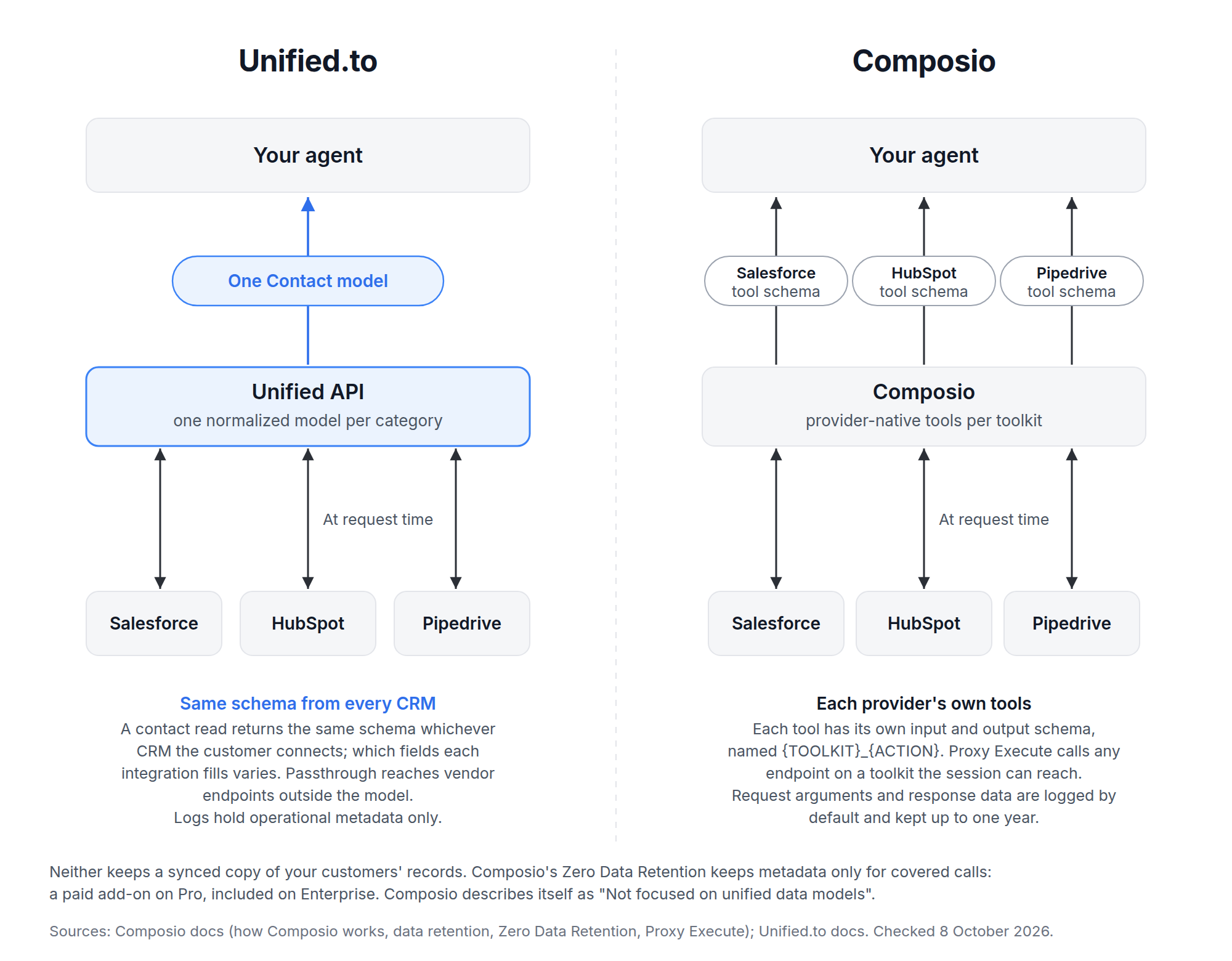
Composio gives agents a separate set of provider-native tools for each app and calls the provider at request time with the stored credential. Unified.to also calls each source at request time, but maps every integration in a category to one normalized model and adds change events and Database Sync (Grow, Pro and Scale, on objects with change events) on top.
Composio. Composio describes itself as "The Skill Layer of AI" (llms.txt), and its own comparison of agent connectors marks Composio "Not focused on unified data models". Each tool has its own input and output schema and follows a {TOOLKIT}_{ACTION} naming pattern, such as SALESFORCE_UPDATE_OPPORTUNITY (how Composio works). The only toolkits that span providers are Composio Search and wrapped third-party aggregators. Proxy Execute calls any endpoint on a toolkit the session can reach, with Composio injecting the authentication (Proxy Execute).
- Change events. Composio offers triggers, by webhook or polling, on selected toolkits. Realtime triggers arrive when the provider sends the event; polling triggers run every 15 minutes on Composio-managed OAuth apps, or as often as every minute with your own app (triggers).
Unified.to**.** Unified.to maps each category to one normalized model: a CRM contact read returns the same schema whether the customer connects Salesforce, HubSpot or Pipedrive, and an Employee uses one model across Workday, BambooHR and Gusto; which fields each integration fills varies, and each integration's page lists them. An accounting invoice, for example, has 40 top-level fields, 25 line-item fields and one 10-value status enum, so an agent reads one status set instead of each ledger's own. Normalized models remove per-vendor branching from your prompts and code; Passthrough reaches any vendor endpoint outside the model when you need the vendor's full detail. The Metadata API looks up custom fields (support varies by integration). For the request-time design, see pass-through vs. sync-based unified APIs; for a worked CRM example, see the CRM API integration guide.
- Change events. Native webhooks deliver changes where the source sends them; where it does not, virtual webhooks detect changes and deliver events at a 1-minute minimum interval on paid plans; where supported, the event carries the changed record. Check each integration's Feature Support tab.
- Database Sync. On Grow, Pro and Scale, writes records for objects with native or virtual webhooks into your own MongoDB, MySQL, Postgres, MSSQL, MariaDB, Supabase or Snowflake database.
Which integration categories does each one cover?
Composio covers more apps overall, about 1,600 toolkits against Unified.to's 1787 integrations, but in HR, payroll, recruiting and accounting Unified.to covers systems Composio does not list, including ADP, Rippling, Paychex, iCIMS, Sage and MYOB. Composio's catalogue is widest in developer tools, productivity and AI services.
Coverage by category: Composio toolkits (counted 8 October 2026) and Unified.to integrations
| Category | Composio directory category | Composio toolkits | Composio examples | Not found on Composio | Unified.to integrations |
|---|---|---|---|---|---|
| CRM | CRM | 67 | Salesforce, HubSpot, Pipedrive, Dynamics 365, Zoho, Attio; also prospecting and enrichment tools such as Apollo, Clay and ZoomInfo | n/a | 235 |
| HR and payroll | HR & Recruiting (shared with recruiting) | 26 | Workday, BambooHR, Gusto, Personio, SAP SuccessFactors | ADP, Rippling, HiBob, Deel, Paychex, UKG, Paylocity, Dayforce | 714 |
| Recruiting (ATS) | HR & Recruiting (same 26) | see HR and payroll | Greenhouse, Lever, Ashby, Workable, Recruitee | iCIMS, SmartRecruiters, Jobvite, Teamtailor | 168 |
| Accounting | Finance & Accounting | 94 | QuickBooks, Xero, NetSuite, FreshBooks, Zoho Books; most of the category is payments, market data and crypto | Sage, MYOB, Microsoft Dynamics 365 Business Central | 279 |
| Ticketing | Sales & Customer Support | 98 | Zendesk, Freshdesk, Intercom, Gorgias, Help Scout; the category also holds sales prospecting tools | n/a | 47 |
| Calendar | Scheduling & Booking | 34 | Google Calendar, Calendly, Cal.com; also travel and booking tools | n/a | 78 |
| LMS | Education & LMS | 19 | Canvas, Blackboard, D2L Brightspace, Google Classroom | n/a | 50 |
| Commerce | E-commerce | 47 | Shopify, Square, Wix, Lightspeed | n/a | 235 |
| Developer tools (where Composio is broader) | Developer Tools & DevOps | 201 | GitHub, GitLab, Vercel, Supabase | n/a | 9 (repository category only) |
| Composio counts are from its toolkit directory on 8 October 2026: the count Composio shows for each category in the directory sidebar. A toolkit in two categories counts in both. Composio's categories are its own and include tools outside the category name (for example, enrichment tools under CRM). "Not found" means no toolkit with that name or slug among Composio's 1,603 toolkit pages. Unified.to figures: Unified.to integrations. |
How do Composio and Unified MCP compare for AI agents?
Composio and Unified MCP both serve tools to agents over hosted MCP, and differ in how the agent's tool list is narrowed: Composio searches its catalogue at runtime through meta tools, while Unified MCP limits the tool list up front with permissions and tools set in a connection-scoped URL. As of 8 October 2026, Composio advertises 20,000+ tools and its toolkit pages list 53,913 to 59,113; Unified MCP serves 22,566. Both totals count every callable tool: Composio's are per provider, and Unified.to's include normalized tools and each vendor's own endpoints. Normalized tools also write: one creates a contact in whichever connected CRM supports contact writes.
Composio (as of 8 October 2026)
- Sessions. A session (formerly Tool Router) "gives the agent meta tools to discover, authenticate, and execute app tools at runtime, instead of loading hundreds of tool definitions into context". You can allowlist toolkits, tools and tags, and a session resolves to at most 1,000 tools; meta tools can run up to 50 tools in parallel.
- Session MCP endpoint. MCP is opt-in (
mcp: true). The endpoint is Streamable HTTP, POST only, and takes a Composio API key in a header, so the URL alone does not authenticate (sessions via MCP). - Composio Connect. One MCP server at
connect.composio.dev/mcpfor Composio's "For You" product, which connects agents you already use (Composio Connect). - MCP Gateway. One governed MCP endpoint per team, on a sales-led product page with no published docs (MCP Gateway).
- Framework packages. 13 Python and 11 TypeScript provider packages cover agent frameworks and model SDKs, including LangChain, LangGraph, LlamaIndex, CrewAI, OpenAI Agents, Claude Agent SDK, Vercel AI SDK, Mastra, Autogen and Google ADK; there is no tool-format option on MCP or REST (providers).
- Your own MCP servers. Custom MCP adds remote MCP servers to a session, up to 500 tools; Composio labels it experimental.
- Sandbox. A remote sandbox (formerly "workbench") handles large payloads and bulk work.
- MCP revision. Composio does not state which MCP revision it supports.
Unified MCP, with each connection's tool list set up front rather than searched at runtime
- Connection-scoped URLs. Unified MCP generates a connection-scoped signed token good for one connection and nothing else, so the workspace API key stays on your side; send tokens in the
Authorizationheader, since?token=in the URL is deprecated;permissions(named scopes, such as read-only CRM) andtools(tool IDs or patterns) are set in the URL. Its tool list depends on the integration's feature support and those permissions: as of 8 October 2026, 30 CRM tools for HubSpot, 12 Ticketing tools for Zendesk. - Tool loading. Most models handle limited tool counts (Groq 10, most OpenAI models 20, Cohere about 50, per Unified.to's docs).
defer_toolsmarks tools for deferred loading,aliasesadd descriptions for tool matching, andinclude_external_toolsadds each vendor's own endpoints as tools. - Transport. Unified MCP is Streamable HTTP only and supports the stateless core of the 2026-07-28 MCP revision in production; stdio-only clients use
mcp-remote. - Sensitive data.
hide_sensitivestrips PII fields such as names, emails, phone numbers, addresses, gender, date of birth, SSN/SIN and compensation, plus credential fields, from tool results before they reach the model; it is opt-in. - Enterprise-managed authentication. Enabled per workspace on request: your identity provider issues an ID-JAG for the end user, exchanged at
POST /oauth/tokenfor anema_bearer token whose scopes, such ascrm.read, filter the tools offered. It is not available for the passthrough, auth, SAML, SCIM or metadata categories, or withinclude_external_tools. RFC 9728 protected-resource metadata lets MCP clients discover how to authenticate. - OAuth sign-in. An MCP client that supports OAuth, such as a Claude custom connector, can point at the bare
/mcpURL and sign in to Unified.to itself (dynamic client registration, PKCE). The access token lasts 24 hours and gives the Core Unified API tools only, scoped bymcp:readandmcp:write. A workspace IP allowlist applies to workspace API keys andema_tokens over MCP; connection-scoped and OAuth tokens are not held to it. - Outside MCP.
GET /toolsreturns the same tools in OpenAI, Gemini, Cohere, Grok and Groq formats; for Anthropic's Messages API, use the OpenAI format and renameparameterstoinput_schema. Each tool call, and each MCP Events poll, counts as one API call on your plan, and tool calls are checked against your workspace rate limit before they run (Unified MCP documentation). - Core mode and coding agents. Core Unified API mode manages workspace configuration and does not read or write end-customer data. One Claude Code plugin installs its MCP server and Unified.to's Agent Skills (
SKILL.mdpackages for building against each Unified.to API); Codex, Cursor, GitHub Copilot and Windsurf add the skills withnpx skills add https://docs.unified.to.
How do authorization and credentials work?
Composio and Unified.to both run each end user's OAuth flow and store connection credentials. Composio adds Composio-managed OAuth apps so users can connect before you register your own; Unified.to lets Pro and Scale customers keep credentials in their own secrets manager.
Composio (as of 8 October 2026)
- Connect Link. "The Connect Link is the hosted page your users see when connecting their accounts." Your logo and name are on every plan; advanced white-labelling is a one-time $0.30 per connection on Pro and included on Enterprise. The page stays on Composio's domain; only the OAuth redirect can be passed through yours.
- Managed OAuth apps. "Composio registers and maintains OAuth apps for popular toolkits such as GitHub, Gmail, and Slack": 123 toolkits as of 8 October 2026. Users still see a consent screen saying "Composio wants to access your account.", and "Managed apps share quota across all Composio users". Any OAuth toolkit accepts your own app (managed vs. custom apps).
- Storage and refresh. Credentials are encrypted at rest with AES-256-GCM and OAuth tokens refresh automatically. "Provider credentials are not required in prompts, tool arguments, or model context." Deleting a connected account does not revoke the token at the provider; Composio's docs say to call revoke first, then delete (token custody).
- Customer-managed keys. On Enterprise, credentials for your own auth configs are encrypted with keys you hold, through a keyring proxy you run with AWS KMS, Google Cloud KMS or HashiCorp Vault Transit.
Unified.to
- Flows. OAuth 2.0 and 2.1 across its integrations, your own OAuth app, embedded authorization components for React, Angular, Vue, Svelte and plain JavaScript, and an authorization CNAME (US and EU regions) on Pro and Scale.
- Storage. Unified.to stores connection credentials, encrypted at rest, unless you keep them in your own secrets manager. More detail: how to handle OAuth across many integrations.
What happens to your customers' data?
Neither Composio nor Unified.to keeps a synced copy of your customers' records; they differ on what their logs hold.
- Composio payload logs. Composio logs "the request arguments and response data for each tool execution" and trigger payloads by default, keeps them "for up to one year", and says "This retention policy applies on every plan" (data retention). Its Logs API returns each execution's request payload and response body.
- Composio Zero Data Retention. ZDR keeps metadata only for covered calls; it costs $0.0001 per call on Pro and is included on Enterprise. It excludes triggers, the sandbox and files, covers Composio-managed apps only on Enterprise, and logs written before you turn it on keep their payloads for up to a year (Zero Data Retention). Audit logs and telemetry are stored on every plan either way.
- Conflicting Composio page. Composio's MCP Gateway page says "Tool-call payloads are never stored"; its docs say otherwise.
- Composio and training. Composio's trust centre says it does not train on customer data: "No, Composio doesn't use customer data or toolkits data."
- Unified.to**.** Unified.to routes each authorized request to the source API. Its logs record endpoint, timing, status and workspace, kept 60 days on Grow and Pro and 365 days on Scale; Pro and Scale can ship logs to Datadog, Grafana and ClickHouse.
Where can each one run?
Composio Cloud runs only in the United States, and Unified.to is hosted in one region per workspace: US on every plan, EU or AU on Pro and Scale. Both offer Enterprise hosting outside the shared cloud: Composio in your VPC or self-hosted, Unified.to on-prem, in a private or dedicated cloud, or single-tenant.
- Composio Cloud. Runs on AWS us-east-1 (subprocessors). Composio's enterprise page lists "Teams requiring EU data residency on managed cloud without self-hosting" among the buyers it does not suit.
- Composio in your cloud. "Self-hosting is available at the Enterprise tier", with a Helm chart from Composio's Enterprise portal, and your team takes responsibility for the agreed infrastructure and operations (Composio Enterprise). As of 8 October 2026, Composio names no supported clouds.
- Unified.to hosted. On Grow, Pro and Scale, Unified.to runs the API and the MCP server: US
https://mcp-api.unified.to/mcp, EUhttps://mcp-api-eu.unified.to/mcp, AUhttps://api-au.unified.to/mcp. The US region is on every plan, and the EU and AU regions on Pro and Scale. A credential works only on its own region's host. Multi-Region Sync is on Scale. - Unified.to Enterprise. On-prem, private cloud, dedicated cloud or single-tenant hosting, including Unified MCP, which runs as part of the Unified API (Unified.to security). Unified.to publishes no Helm chart and has no open-source MCP server.
How does pricing compare?
Composio is free to start and $29 a month on Pro, billed per tool call with unlimited connected accounts ($0.10 each, once, for Composio-managed-app connections after the first 1,000); Unified.to starts at $750 a month with a 30-day free trial, billed per API call with unlimited connections. Prices as of 8 October 2026; Composio's apply to sign-ups from 15 August 2026, and existing Composio customers stay on their plans through 31 December 2026.
| Plan | Composio | Unified.to |
|---|---|---|
| Entry | Hobby: $0; 100,000 tool calls and 50,000 trigger events a month; three team members; no credit card; hard-capped | 30-day free trial on Grow and Pro |
| First paid plan | Pro: $29 a month including $29 of usage; then $0.0003 per tool call and $0.003 per trigger event; portal support, with email and Slack support listed "at $1K" | Grow: from $750 a month; 750,000 API calls a month, then $1.00 per 1,000; unlimited connections |
| Mid plan | None | Pro: from $1,500 a month; 2,000,000 API calls a month, then $0.75 per 1,000; unlimited connections |
| Upper plan | Enterprise: custom; committed volume and discounts, annual invoicing, dedicated support and SLA | Scale: from $3,000 a month; 6,000,000 API calls a month, then $0.50 per 1,000; unlimited connections. Enterprise: custom |
| Per-call add-ons on the first paid plan | Zero Data Retention $0.0001, IP allowlisting $0.0001, BAA $0.0003, proxy calls $0.0002, shared-connection calls $0.0003, and direct execution and sandbox $0.0001 each, all per call; calls through Composio-managed apps $0.0005 each ($0.0002 above the base rate) after the first 20,000 | None; each MCP tool call and each MCP Events poll counts as one API call |
| Billed unit | Tool calls and trigger events; meta tools are free | API calls |
| Sources: Composio pricing; Unified.to pricing. At Composio Pro's $0.0003 rate, 750,000 tool calls come to about $195 a month before add-ons, with the first 100,000 calls a month free, against $750 for the same volume on Unified.to Grow, so Composio costs less on call volume alone (our calculation from both vendors' published pricing). The Unified.to price covers one normalized model per category, so one call reads or writes a contact in whichever supported CRM the customer connects; Composio's tools are per provider, and Composio describes itself as "Not focused on unified data models". Composio's Instant Tools (formerly Premium Tools: search, enrichment and AI-model APIs run on Composio's provider accounts) add provider charges at cost on top of the call. For how per-call and per-connection pricing behave as you grow, see usage-based vs. per-connection pricing. |
How do security and compliance compare?
Composio holds a SOC 2 Type II report and ISO/IEC 27001:2022 certification; Unified.to has a SOC 2 Type II report and states GDPR, CCPA/CPRA, PIPEDA and HIPAA compliance. Unified.to puts its BAA on Scale and SAML SSO on Pro and Scale.
- Composio certifications. SOC 2 Type II for calendar 2025 (report dated 12 March 2026) and ISO/IEC 27001:2022 (certified 22 September 2026), both on Composio's trust centre.
- Composio BAA and DPA. A BAA is a Pro add-on at $0.0003 per tool call and included on Enterprise (published 28 August 2026). The DPA covers GDPR and CCPA service-provider terms with standard contractual clauses on Pro and Enterprise. Composio makes no GDPR, CCPA or HIPAA compliance claim and does not mention PIPEDA.
- Composio access controls. As of 8 October 2026, SAML or OIDC SSO with SCIM is Enterprise only; MFA can be enforced; per-key IP allowlisting is a Pro add-on and included on Enterprise; admin and developer roles, plus a read-only dashboard role on Pro and Enterprise.
- Composio content filtering. Composio says "Your application is responsible for content-level safeguards, including sensitive-data filtering and redaction before tool results reach the model."
- Composio incident. In May 2026, an attacker accessed internal Composio systems and compromised customer credentials, which Composio says affected about 0.3% of active connections, including 5,001 GitHub connections, with 5,241 Composio API keys separately identified as potentially exposed; Composio lists envelope encryption for OAuth credentials, hashing of API keys and redaction of tokens in API responses among its remediation (Composio incident report, updated 16 September 2026).
- Unified.to**.** SOC 2 Type II; 2026 report on request through the trust centre. IP restriction is on Pro and Scale; compliance details are on Unified.to security.
How did Mycroft ship integrations with Unified.to?
Mycroft, an AI-driven security and compliance platform for organizations with 50+ employees, cut its integration launch time to 15 minutes with Unified.to and freed up 25% of its development time for core product work, according to the Mycroft case study (January 2025).
Mycroft's customers are organizations with 50+ employees and many SaaS applications, and each integration had taken engineering time to build, test and maintain. With pre-built integrations, and Unified.to handling authorization, Mycroft had 15 integrations live at the time of the case study. One normalized model per category means one integration per category instead of one per vendor.
Which should you choose?
Choose Composio when your agent acts across many developer, productivity and AI tools, or when you need a free start; choose Unified.to when your product reads and writes the same records across many vendors in one category, such as CRM, HRIS, ATS or accounting. If every customer uses the same provider, a direct integration or a specialist may be simpler than either.
| If you need... | Choose | Why (as of 8 October 2026) |
|---|---|---|
| An agent that acts across a long tail of developer, productivity, search and AI-model tools | Composio | About 1,600 provider-native toolkits, with runtime tool search across them |
| A free start or the lowest entry price | Composio | "The Hobby plan is hard-capped, needs no credit card, and never produces a surprise bill"; Unified.to's price buys one normalized model per category |
| End users connecting before you register OAuth apps | Composio | Composio-managed OAuth apps for 123 toolkits (Composio branding, shared quota) |
| A BAA on the lowest-priced paid plan | Composio | BAA as a paid add-on on Pro ($0.0003 per tool call); Unified.to's BAA is on Scale, and its logs hold operational metadata only, where Composio logs tool request and response data for up to a year by default |
| ISO 27001 | Composio | Certified 22 September 2026; Unified.to does not hold it |
| To self-host from a Helm chart, or EU residency through your own deployment | Composio | Helm chart from the Enterprise portal; Unified.to's Enterprise hosting has no published Helm chart |
| Packages for your agent framework, such as LangChain, CrewAI or Mastra | Composio | 13 Python and 11 TypeScript provider packages; Unified.to serves MCP and tool lists in five LLM formats |
| One agent tool that works across each supported CRM, HRIS, ATS or accounting system | Unified.to | Normalized tools per category; Composio's tools are per provider |
| ADP, Rippling, Paychex, Deel, UKG, Paylocity, iCIMS, SmartRecruiters, Sage or MYOB | Unified.to | No Composio toolkit for any of them |
| No tool payloads stored | Unified.to | Composio logs request and response data for up to a year by default |
| Records written into your own database | Unified.to | Database Sync (Grow, Pro and Scale) to MongoDB, MySQL, Postgres, MSSQL, MariaDB, Supabase or Snowflake, for objects with native or virtual webhooks |
| Data in the EU or Australia without self-hosting | Unified.to | EU and AU workspace regions on Pro and Scale |
| To take your customers' connections with you if you leave | Unified.to | The API returns tokens, and those from your own OAuth app keep refreshing; Composio does not support token export |
| SAML SSO or your own secrets manager below Enterprise | Unified.to | Pro and Scale; Composio has SSO and customer-managed keys on Enterprise only |
| Category records (CRM, HR, accounting) plus developer and productivity tools in one agent | Both | Unified.to for the category records, Composio for the long tail |
| Every customer on the same provider | Neither | A direct integration or a specialist may be simpler |
| The answer can differ by category inside one product: productivity, developer-tool and messaging features may point to Composio, while CRM, HRIS, ATS and accounting features point to Unified.to, and a product can use both. For another MCP comparison, see StackOne vs. Unified.to; for unified API alternatives, see Top Merge.dev Alternatives in 2026. |
Frequently asked questions
What if I just want Claude or ChatGPT to access my own SaaS data, not build a B2B product? Use UnifiedMCP or Composio's "For You" product rather than either developer platform. Unified.to operates UnifiedMCP for individuals and internal teams who want to connect ChatGPT, Claude, Gemini or Cursor to their own accounts, such as Salesforce, HubSpot, Slack, Stripe and Notion, without writing code: connect an account, copy the MCP server URL into your AI client, and set the guardrails. Composio's equivalent is "For You" ("Use Composio yourself with agents you already have"), served through Composio Connect.
What happens to my customers' connections if I leave?
On Unified.to, the API returns each connection's tokens, and tokens issued to your own OAuth app keep refreshing after you leave, so your customers don't reconnect. As of 8 October 2026, Composio says reading connected-account state "is not a supported token-export workflow" and redacts tokens in API responses (since 4 June 2026) (Composio token custody). Moving from Composio to Unified.to therefore means customers re-authorize connections Composio stores (credentials you already pass to Composio yourself can be imported); Unified.to's migration overview covers that path, including passing your customer ID as external_xref.
For how Composio and Unified MCP compare with eight other MCP servers, see Best MCP Servers for Connecting AI Agents to SaaS APIs.
Start your 30-day free trial of Unified.to or book a demo to see how the coverage and architecture fit your product.
Written by Mallory Greene.
About the author: Mallory Greene is Head of Marketing at Unified.to_. She writes about integration infrastructure, unified APIs, and MCP for technical teams. Based in Toronto._