
Merge vs. Unified.to: Which Unified API Should You Choose in 2026?
April 9, 2025
Choose Merge if your product reads the same records repeatedly and benefits from a stored copy, you want per-customer field mapping managed for you, or your security review requires ISO 27001. Choose Unified.to if you can't let a third party keep a copy of customer data, need coverage beyond Merge's eight categories, or want cost that tracks API usage instead of customer count.
Merge and Unified.to are both unified APIs: each normalizes hundreds of B2B SaaS integrations into common data models, so you build against one schema per category instead of one integration at a time. (Unified API is the category; Unified.to is the company.) The biggest difference between them is custody. By default, Merge syncs your customers' data into its own database on a schedule and serves normalized records from that copy. Unified.to routes each request to the source and returns the response without storing it. In our view, that one choice explains most of the differences in what each platform charges for, what it gates behind a contract, and what it takes to leave. Unified.to covers 1313 integrations across 36 categories.
What are Merge's and Unified.to's strengths and limits?
Merge offers a write toolkit (/meta field discovery, idempotency keys, async and bulk writes), saved per-customer Field Mapping and ISO 27001. By default it syncs your customers' data into its own database and serves normalized reads from that copy. Its one published price is Launch, which it describes as a proof of concept; Remote Data, Passthrough, Field Mapping, third-party webhooks and faster syncs start at the contract-priced Professional plan. It covers eight categories.
Unified.to passes each request through to the source and stores no customer records. It covers 36 categories with 1313 integrations, publishes three plans priced by API call with unlimited connections, and includes raw fields, Passthrough and Database Sync on every plan. On integrations both support, it creates or updates objects that Merge's matrices show as read-only, such as employees on HiBob and jobs on Lever. Its limits are real too: no ISO 27001, no saved per-customer field mapping, no reconciliation for deletions the source doesn't announce beyond ten integrations, and you register your own OAuth apps before production.
How this comparison was built. This post was written by Unified.to. We compared Merge Unified and Unified.to from each company's public documentation, pricing pages, field-support matrices, API references and contract terms, retrieved 30 September to 2 October 2026, with Unified.to's October payroll release and catalogue additions updated on 8 October 2026, plus attributed quotes from Unified.to customers. We didn't test Merge hands-on. Plans compared: Merge Launch (published), one Merge Professional bundle (AWS Marketplace), and Unified.to Grow, Pro and Scale. Merge doesn't publish Professional or Enterprise prices. Where Merge is the better choice, the post says so.
Key takeaways
- Both receive the source's webhooks where it sends them and poll where it doesn't. The real difference is custody: Merge stores your customers' data and credentials until you delete them, and Unified.to stores no customer records.
- Merge Launch is free for 3 Linked Accounts, $650 a month for up to 10, then $65 each. Unified.to charges per API call with unlimited connections. By our calculation on published rates as of October 2026, the break-even is 65,000 to 130,000 calls per connection per month at any count from 12 connections up. Launch is Merge's proof-of-concept plan: webhooks from the source, faster sync, Remote Data, Passthrough and Field Mapping start at the contract-priced Professional plan.
- Merge publishes a price for one plan and calls that plan a proof of concept. The plan it calls "the best fit for most companies" is contract-based. Unified.to publishes Grow, Pro and Scale.
- On the 174 integrations both supported on 2 October 2026, Unified.to creates or updates 226 objects that Merge's matrices show as read-only, and Merge writes 30 that Unified.to only reads.
- Moving from Merge, connections on your own OAuth apps can move without a reconnect once Merge shares their credentials, with each customer's consent; customers on Merge's apps reconnect. Leaving Unified.to, your customers' tokens leave with you.
How do Merge and Unified.to compare?
Merge stores a normalized copy of your customers' data and prices per Linked Account; Unified.to stores no customer records and prices per API call with unlimited connections. As of October 2026, the rest of the differences line up like this:
| Merge | Unified.to | |
|---|---|---|
| Where customer data lives | Stores normalized customer data and credentials by default, until you delete them. Destinations can stream data to your own storage | Stores no customer records. Connection credentials and minimal operational metadata persist, encrypted |
| Categories and integrations | 8 categories, per Merge's API reference. Merge publishes its catalogue on its integrations page | 36 categories and 1313 integrations, every category on every plan |
| Write support | Writes go to the source at request time. Chat (Microsoft Teams) is read-only in Merge's published matrix | Writes go to the source at request time, including Microsoft Teams messages. Each integration's Feature Support tab shows what it writes |
| Change events | Merge webhooks on every plan. Webhooks from the source need Professional or Enterprise; Launch refreshes daily | Native webhooks where the source sends them; virtual webhooks on supported integrations and objects, down to a 1-minute interval on paid plans. Checks that find nothing aren't billed |
| Custom fields, raw data, unmapped endpoints | Remote Data, Remote Fields, Field Mappings, Passthrough and custom objects on Professional and Enterprise, including saved per-customer mapping | Raw fields, Metadata API and Passthrough API on every plan. No saved per-customer mapping |
| Pricing model | Per production Linked Account | Per API call, unlimited connections on Grow, Pro and Scale. Enterprise can be usage- or connections-based |
| Published entry price (2026) | Launch: first 3 Linked Accounts free, $650/month up to 10, $65 each after. "For early-stage startups that want to build a proof of concept" | Grow: from $750/month for 750,000 API calls. "For production applications with growing customer usage" |
| Authorization and branding | Merge's own OAuth app on some integrations (Linear, Google Drive, Box); your own on others (QuickBooks Online, Xero, Dropbox, Notion). Link customization and white-labelling are Enterprise | Your own OAuth app in production, so the consent screen shows your app. Auth CNAME on Pro and Scale (US and EU regions) |
What is actually different between Merge and Unified.to?
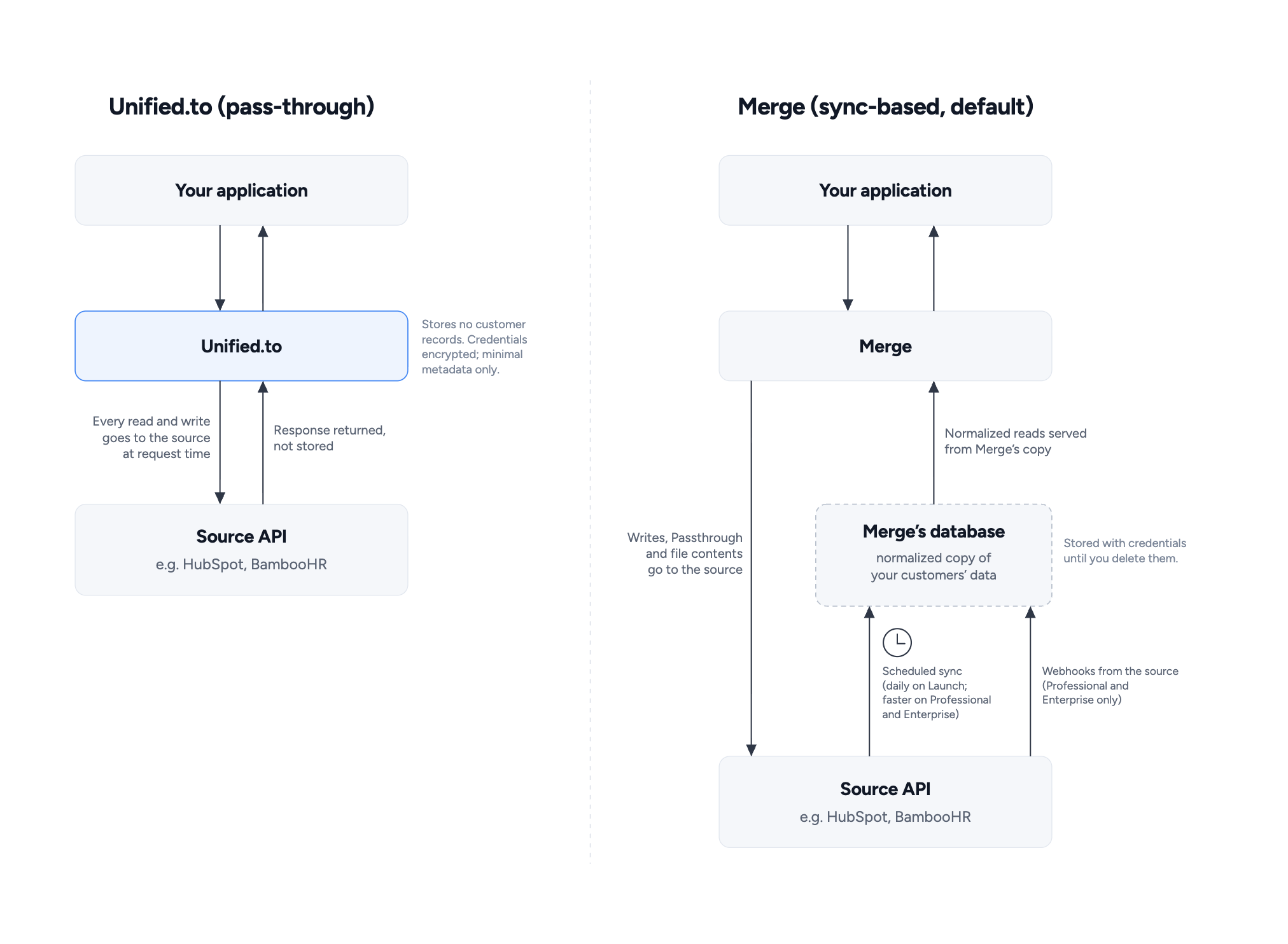
The main difference between Merge and Unified.to is custody: Merge stores a normalized copy of your customers' data and their credentials. Unified.to stores no customer records.
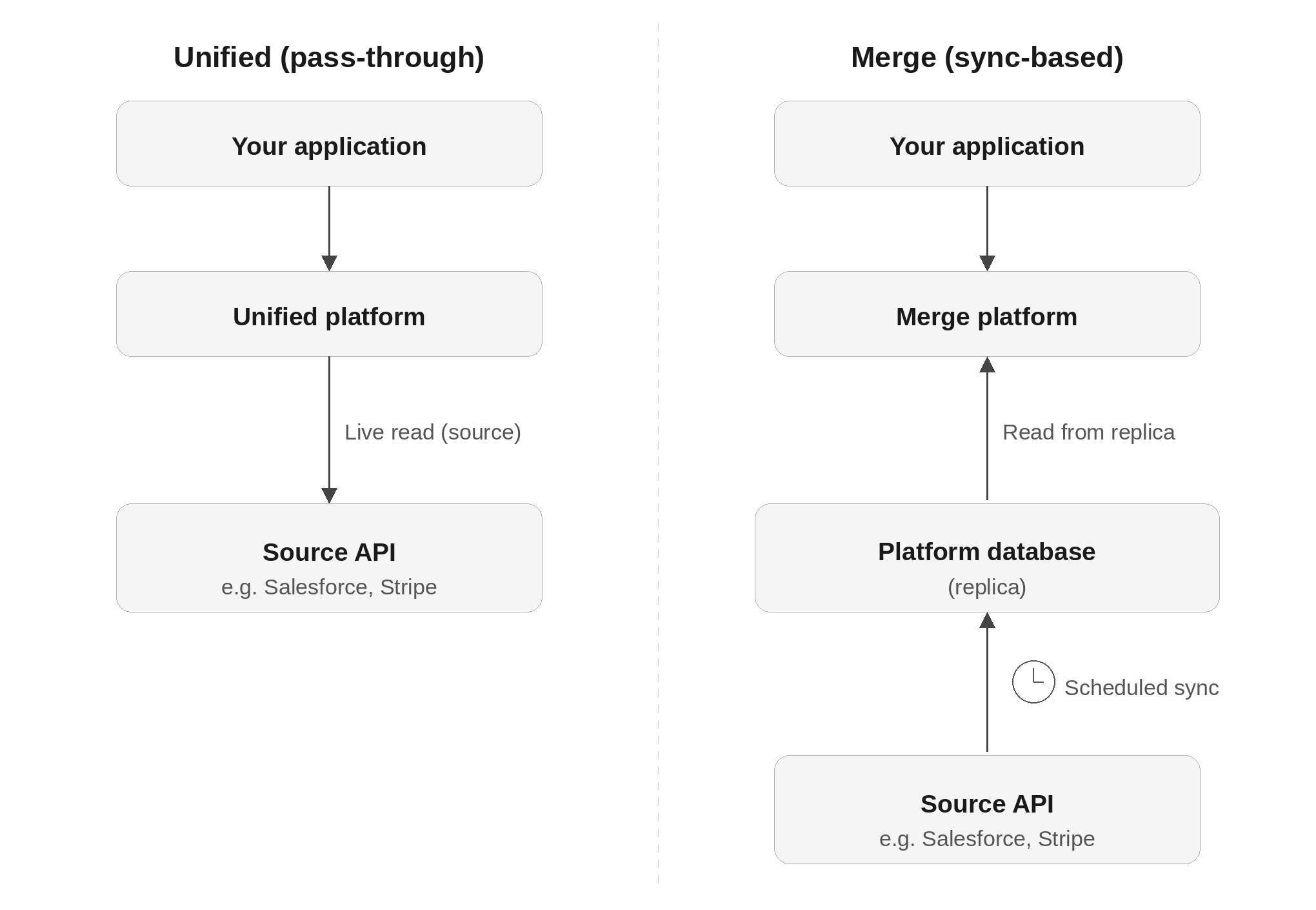
The architectural split is what happens to a record after it's fetched. On Merge, synced records land in a database Merge runs, and normalized reads are served from that copy, refreshed by scheduled syncs and, on Professional and Enterprise, by webhooks from the source. Passthrough requests and file contents still go to the source. On Unified.to, every request goes to the source and no customer records stay behind.
Here is Merge's own architecture reference, describing the three parties in a Merge integration:
"Merge handles authentication with third-party platforms, runs syncs on a schedule, normalizes data into Common Models, and delivers webhooks when data changes."
And, in the same document:
"The third-party platform (BambooHR, Greenhouse, HubSpot, etc.) is the source of truth. Merge reads from and writes to it on your behalf."
Merge calls the third-party platform the source of truth, which is another way of saying Merge's copy isn't. Unified.to routes each request to the source at request time and streams the response back without retaining it. It stores connection credentials, encrypted, and minimal operational metadata such as IDs and timestamps.
Custody buys Merge real things, and they're worth naming first. Every Merge plan includes unlimited data usage, so reading the same records again doesn't add to the bill. Merge says storing data lets it sync while respecting each provider's rate limits, and that its internal database makes customers less vulnerable to third-party outages. These are properties of holding a copy. A pass-through platform trades them for current data and no stored customer records.
The cost is the mirror image. A normalized record is as current as the last sync or source event that updated it. A copy of someone else's data drifts.
Our read: several of the controls Merge offers exist because Merge holds the data.
- Field-level scopes ("field-level scopes for enhanced data minimization," in Merge's words) limit what lands in Merge's database. All plans get Common Model Scopes; editing field-level scopes requires Professional or Enterprise.
- Enhanced deleted data reconciles Merge's copy against the source when the source doesn't announce deletions. Paid add-on, annual Professional or Enterprise.
- Merge's MSA grants Merge "a limited license during the Term to use Customer Data to provide and maintain the Service" (Section 4.1), and commits that Merge "will not, and will not allow any third party to, use Customer Data to train, fine-tune, or improve any AI" (Section 4.5). That's a real commitment, and it's necessary because there is stored Customer Data to make a commitment about. (Merge MSA, last updated September 9, 2026)
- Merge's MSA obligates Merge to delete Customer Data on written request at termination (Section 5.3).
None of those are criticisms of Merge's engineering. They're consequences of the model. A platform that stores no customer records has none of those to scope, reconcile or delete.
What Merge stores does vary by category. For File Storage, Merge's help centre says it holds metadata and permissions but not file contents, fetching those on demand. Merge also offers Destinations, which streams normalized data into your own storage instead of Merge's. By default, Merge stores synced data and credentials until you delete them.
Do Merge and Unified.to get data the same way?
Merge and Unified.to both receive the source's webhooks where it sends them and poll where it doesn't. That part is table stakes, not a differentiator, and any comparison claiming one polls and the other doesn't is describing marketing rather than either product. What differs is where the polled data lands.
How do changes reach Merge?
Merge runs two webhook types. Third-party webhooks are configured in the source platform so it sends changes to Merge, which Merge says gives you real-time updates regardless of the rate at which Merge syncs data. Merge then sends its own webhooks to your app, carrying the affected data model. Where a source has no webhook support, Merge falls back to its scheduled sync. One thing Merge's docs are explicit about, and it matters: third-party webhooks are available only on Professional and Enterprise plans. On Launch, Merge doesn't receive webhooks from the source, so changes reach Merge on the daily sync. Merge's own webhooks to your app are on every plan.
On Professional and Enterprise, Merge does something useful here: on supported integrations its Automatic Webhooks feature, once enabled in Merge's dashboard, sets those third-party webhooks up for you, with no configuration from your end user. Unified.to's own comparison table concedes that native webhooks "may require additional configuration on other platforms." If your customers would otherwise have to paste a listener URL into their HRIS, that difference is real, provided you're on Professional or Enterprise, since that's where third-party webhooks live.
How does Unified.to handle change events?
Unified.to uses native webhooks, which relay the source's own events, and virtual webhooks, which poll on an interval you set and send only what changed. Unified.to's docs are direct about why virtual webhooks exist at all: "Most APIs do not support webhooks natively."
Both kinds of webhook can also load history. Set include_all when you create the webhook, and Unified.to delivers the existing records in pages marked INITIAL-PARTIAL, ending with INITIAL-COMPLETE, then carries on with changes. Backfill works on integrations that support an initial sync, which each integration's Feature Support tab shows.
How current is the data on each?
On Merge, normalized records are as current as the last sync or source webhook that updated them: daily on Launch, and up to each integration's published Highest setting on Professional and Enterprise. On Unified.to, reads go to the source, and change events arrive when the source sends them or at the virtual webhook interval you set, down to one minute on paid plans.
So both are fast where the source is fast and scheduled where it isn't. The mechanism is shared; the destination isn't. Merge's poll writes to Merge's database, and your read comes back out of it later. Unified.to's poll goes straight to your endpoint or your database and leaves no customer records behind. Two things follow from that.
Does Merge recommend polling as well as webhooks?
Merge tells you to keep polling anyway. Its architecture reference recommends "a combination of webhooks and polling," and its syncing guidance says not to rely entirely on notification webhooks, because webhooks fail from downtime or failed processing. Merge still recommends calling your sync functions every 24 hours, using modified_after to fetch only what changed.
How often does Merge sync on each plan?
Daily is Merge's sync frequency on Launch. On Professional and Enterprise it's customizable, up to each integration's published Highest setting, and Merge publishes those per integration and per object. For most objects, Highest is 5 minutes on OneDrive, 1 hour on BambooHR, and 1 day on Box. Same plan, and the cadence depends on the integration. Merge says those settings are tuned to each provider's rate limits, and its pages describe when a sync starts, not when it finishes.
Pro tip: before you set a one-minute interval on Unified.to, model the bill. Each page of changes a run delivers is one billable call. Runs that find nothing are free, but a busy connection polled every minute adds up. Failed deliveries aren't billed either. Match the interval to how fast the data needs to arrive.
Can you sync data into your own database?
Merge and Unified.to can both send normalized data into your own storage. Unified.to's Database Sync is on every published plan.
Unified.to's Database Sync writes normalized data from your customers' integrations straight into your own database (MongoDB, MySQL, Postgres, MSSQL, MariaDB, Supabase or Snowflake), delivered by the same native and virtual webhooks that carry change events, so your app reads locally and Unified.to still stores no customer records. Mechanically it's a webhook with a database as the destination instead of a URL, which is visible in the API: the webhook object carries db_type, db_url, and db_schema alongside hook_url. You can send to both. Because it's a webhook, Database Sync covers every object with native or virtual webhooks and nothing else: pay runs, pay codes and Earning emit no change events, and ADP Workforce Now, Gusto, Paycor and Check emit no HR events, so Database Sync can't keep those current.
The same webhooks can feed a retrieval pipeline instead of a database. Point a webhook at the service that chunks and embeds your records, use include_all to load history, and the vector index stays current as records change at the source. Unified.to still keeps no copy; the index lives in your infrastructure.
Unified.to's Database Sync doesn't write to S3 or BigQuery; both are available as integrations your customers can connect.
Here's why this matters for cost. The break-even in the pricing section below says Merge gets cheaper past 65,000 to 130,000 reads per connection per month, depending on how many connections you have (our calculation). At that many reads, Database Sync lets your app read from its own database and stop paying per read. That lowers the bill, but it isn't something Merge lacks: Merge's Destinations also streams normalized data into your own storage. What the higher price buys at that volume is that Unified.to holds no copy of your customers' records, where Merge keeps synced data and credentials until you delete them, and that webhooks from the source and Passthrough come on the entry plan, where Merge starts them at Professional.
What does Database Sync cost?
Database Sync bills like a webhook: each page of data dispatched is one API call, and runs that find nothing are free. Failed deliveries aren't billed. Your cost driver moves from reads your app makes to changes at the source. For example, an app doing 200,000 reads a month against its own database might generate a few thousand billable sync dispatches. The reads themselves cost nothing.
The trade is real and you should take it deliberately. Once you run Database Sync you hold a copy, and a copy can drift. Deletions propagate where the source announces them (a deleted event removes the row from your database) and don't where it doesn't. The problem doesn't disappear. What changes is that the copy sits in your database, under your retention policy and your deletion.
Can you reach custom fields and raw data on every plan?
On Unified.to, yes: raw fields, the Metadata API and the Passthrough API are on every plan. On Merge, Remote Data, Remote Fields, Field Mapping and Passthrough start at the contract-priced Professional plan.
On Merge, the tools for this are Remote Data (the raw response alongside the normalized record), Remote Fields, Field Mappings, Authenticated Passthrough and Custom objects. All five are on Professional and Enterprise, and none is on Launch, the one plan with a published price. Field Mapping through the API is Enterprise-only.
Merge does something here that Unified.to doesn't. Its Field Mapping lets you, or your end user inside Merge Link, save a mapping from a customer's field to your model, and Merge applies it on every sync. Unified.to has no saved per-customer mapping. You read the field from raw or the Metadata API, and your application keeps track of which customer uses which field. If you want mapping managed for you and you're on Professional or Enterprise, that's a point for Merge.
How do Merge's and Unified.to's data models compare?
Merge publishes related data as separate Common Models (Offer, RejectReason, Department, Office, ScreeningQuestion), while Unified.to's models carry it on the parent record: an application carries its offers and rejection reason, and a job carries its departments, offices and screening questions. Merge's expand parameter can return related objects in the same call.
In practice, the difference shows up in two places. When you read, a Unified.to application arrives with its offers attached; on Merge you fetch them as related objects. When you evaluate, a checklist that looks for each resource by name matches Merge more often, because more of its data has its own object. The map below shows where each Merge object's data lives in Unified.to.
The same holds in HR. Merge keeps Employee and Employment as separate objects. On Unified.to, employment type, status, hire and termination dates and compensation are fields on the employee. Across categories, user references in ATS, CRM, Ticketing, Messaging, Storage and Tasks all point to that one employee object through user_id.
Payroll is modelled the way Merge models it. A pay run is its own object (hris_payroll), a pay group is a group type, and each payslip line carries a normalized type (earning, deduction, tax or employer contribution) and the payroll system's pay code (hris_paycode). Earnings (hris_earning) are amounts added to a pay cheque, the counterpart to deductions (hris_deduction), on ADP Workforce Now, Check, Employment Hero Payroll, Gusto, Paychex, Paycor, Paylocity, Remote.com and UKG Pro HCM; methods vary by integration. As of 9 October 2026, pay runs are readable on Check, Deel, Employment Hero Payroll, Gusto, Paychex, Paycor, Remote.com and Rippling, and pay codes on Check, Employment Hero Payroll, Gusto, Paychex and Paycor. Payslips were added or expanded on integrations including ADP Workforce Now, Paylocity and UKG Pro HCM.
In accounting, an invoice's status has 10 values and payment_terms 11, and each line item carries project_id, is_billable, category_ids, taxrate_id and typed fees[] (tax, discount, shipping and others).
Where Unified.to has no equivalent for a Merge object, the map says so; raw and the Passthrough API reach that data in the source.
| Category | Merge object | Unified.to object and field |
|---|---|---|
| HRIS | Employee | hris_employee |
| HRIS | Employment | hris_employee: employment_type, employment_status, hired_at, terminated_at, termination_reason, compensation |
| HRIS | Group | hris_group (TEAM, GROUP, DEPARTMENT, DIVISION, BUSINESS_UNIT); also hris_employee.groups |
| HRIS | Location | hris_location; also hris_employee.locations |
| HRIS | Company | hris_company |
| HRIS | TimeOff | hris_timeoff |
| HRIS | TimeOffBalance | hris_employee.timeoff_days_total, timeoff_days_used |
| HRIS | EmployerBenefit | hris_benefit (the plan: type, employer contribution, coverage level) |
| HRIS | Benefit (an employee's enrolment) | hris_deduction (user_id, benefit_id, amount, employer_amount, coverage_level, frequency, start_at, end_at) |
| HRIS | BankInfo | hris_bankaccount |
| HRIS | EmployeePayrollRun | hris_payslip: pay period, paid_at, gross and net, employee and employer tax, deductions, employer contributions, hours, year-to-date totals and payroll_id; earnings, deductions and taxes as typed lines in details, each with its pay code (hris_paycode) |
| HRIS | PayrollRun | hris_payroll: status, type, pay period, pay date, gross and net, taxes, deductions, employer contributions, total cost, the employees paid and their payslips |
| HRIS | PayGroup | hris_group of type PAY_GROUP; hris_payroll.group_id and hris_payslip.group_id point to it |
| HRIS | Dependent | hris_employee.relationships[] with type (SPOUSE, CHILD and others), is_dependent, is_beneficiary |
| HRIS | TimesheetEntry | hris_attendance (clock-in, clock-out, hours, breaks, approval); scheduled shifts in hris_timeshift |
| ATS | Candidate | ats_candidate |
| ATS | Application | ats_application |
| ATS | Job | ats_job |
| ATS | JobInterviewStage | ats_applicationstatus (scoped per job via job_id) |
| ATS | ScheduledInterview | ats_interview |
| ATS | Scorecard | ats_scorecard |
| ATS | Attachment | ats_document |
| ATS | Activity | ats_activity |
| ATS | Offer | ats_application.offers |
| ATS | RejectReason | ats_application.rejected_reason |
| ATS | Department | ats_job.groups ("departments/divisions/teams") |
| ATS | Office | ats_job.addresses |
| ATS | ScreeningQuestion | ats_job.questions; answers in ats_application.answers |
| ATS | Tag | ats_candidate.tags |
| ATS | RemoteUser | user_id → hris_employee |
| ATS | EEOC | No field in the Candidate model; use raw |
| Ticketing | Ticket | Help desks: ticketing_ticket. Project trackers: task_task |
| Ticketing | Collection | Help desks: ticketing_category (nested via parent_id). Project trackers: task_project ("boards, workspaces and portfolios") |
| Ticketing | Comment | Help desks: ticketing_note. Project trackers: task_comment |
| Ticketing | Contact | ticketing_customer |
| Ticketing | Account | No separate organization object; ticketing_customer has no organization fields |
| Ticketing | Tag | ticketing_ticket.tags; task_task.tags |
| Ticketing | Attachment | ticketing_ticket.attachment_ids; task_task.attachment_ids (Storage files) |
| Ticketing | User | user_id → hris_employee |
| Ticketing | Team | Project trackers: task_project.group_ids and task_task.group_ids → hris_group. Help desks: none |
| Ticketing | Role | No equivalent |
| File Storage | File | storage_file |
| File Storage | Folder | storage_file with type FOLDER |
| File Storage | Permission | storage_file.permissions[]: user_id, group_id, roles (OWNER, READ, WRITE), is_hidden, is_public |
| File Storage | User | user_id → hris_employee |
| File Storage | Group | storage_file.permissions[].group_id → hris_group |
| File Storage | Drive | No field found |
| Knowledge Base | Article | kms_page (title, type, space_id, parent_id, download_url, web_url) |
| Knowledge Base | Container | kms_space (nested through parent_id) |
| Knowledge Base | User | user_id → hris_employee |
| Knowledge Base | Attachment, Group | No field on Page or Space |
| Merge objects from Merge's published Common Models; Unified.to objects and fields from Unified.to's API reference (openapi.json), retrieved 1 October 2026. Merge's Ticketing category covers both help desks and project trackers; Unified.to splits them into Ticketing and Tasks, so those rows name both. |
Which categories can you read from and write to?
Merge covers eight categories: HRIS, ATS, Accounting, CRM, Ticketing, File Storage, Knowledge Base and Chat. Unified.to covers 36, all on every plan. If your product only ever needs one HR system, that difference doesn't matter. It matters when the roadmap moves: a fintech product that starts with accounting usually needs payments, e-commerce and file storage next, and a recruiting product needs calendars and messaging.
Categories Unified.to covers that Merge doesn't include Calendar, E-Commerce, Payments, Marketing, Learning Management, Advertising, E-Signature, Shipping and Enrichment.
Coverage also has a write side. Merge's Chat category has one integration, Microsoft Teams, and its published field matrix shows read operations only. Unified.to's Messaging API writes to messaging integrations, including Microsoft Teams (the message body, the channel and reactions) and Slack, where it also sends attachments. Each integration's Feature Support tab shows which fields it can write.
Which platform writes more on the integrations both support?
On integrations both platforms support, Unified.to writes more often than Merge: comparing Merge's published field matrices with Unified.to's integration support, Unified.to creates or updates records that Merge only reads, such as employees on HiBob, ADP Workforce Now and Paylocity, time off on HiBob, jobs on Lever, leads on HubSpot, accounts on NetSuite and purchase orders on Xero. It runs the other way less often, but it does: Merge writes bank feeds on NetSuite, QuickBooks Online and Xero, expense reports on NetSuite and Sage Intacct, and timesheets on BambooHR and Dayforce, where Unified.to reads only.
Merge's Passthrough reaches the source's own write endpoints on Professional and Enterprise. The difference is whether the write is in the normalized model.
How much do the two catalogues overlap?
As of 2 October 2026, Merge lists 233 integrations across its eight categories. As of 8 October 2026, Unified.to supports 176 of them in the matching category. Another six, including Help Scout, Kustomer and Bitbucket, are on Unified.to under a different category: you can connect them, but their tickets aren't in Unified.to's Ticketing API, so you'd reach that data through Passthrough. The remaining 51 aren't on Unified.to, mostly HR and payroll systems (30, including iSolved, Nmbrs and Planday) and ticketing tools (8, including Wrike, Basecamp and Rally).
| Merge category | Merge lists | Also on Unified.to | Not in the matching Unified.to category | Unified.to only, same category |
|---|---|---|---|---|
| HRIS | 87 | 57 | 30 | 466 |
| ATS | 64 | 55 | 9 | 102 |
| Accounting | 16 | 16 | 0 | 198 |
| CRM | 21 | 17 | 4 | 114 |
| Ticketing (Unified.to Ticketing and Tasks) | 37 | 23 | 14 | 44 |
| File Storage | 5 | 5 | 0 | 75 |
| Knowledge Base | 2 | 2 | 0 | 19 |
| Chat (Unified.to Messaging) | 1 | 1 | 0 | 41 |
| On the 174 integrations both supported on 2 October, Unified.to creates or updates 226 objects that Merge's matrices show as read-only, and Merge writes 30 that Unified.to only reads. Merge reads more objects on some HR and ATS integrations, such as locations, companies and interview stages. These object counts are from 2 October 2026. Unified.to has since added pay runs, pay groups and pay codes, and company and interview-stage objects on more HR and ATS integrations, so the read gap is likely smaller today. |
How we counted: Merge's public supported-fields matrices (retrieved 2 October 2026) against Unified.to's published integration support (1 October 2026). Both are documentation labels, not tested behaviour. Integration counts include ADP RUN and Re:amaze, which Unified.to added on 7 October 2026; object counts and the Unified.to-only column are as of 1 October. Deletes aren't counted, and product editions are matched only to the same edition.
How much does Merge cost compared to Unified.to?
As of October 2026, Merge Launch is free for the first 3 production Linked Accounts, $650 a month for up to 10, then $65 a month for each one after that. Professional and Enterprise are contract-based. Unified.to's Grow, Pro and Scale plans charge per API call, from $1.00 per 1,000 on Grow, with unlimited connections.
Both platforms define the connection identically. Merge calls it a Linked Account: one customer connected to one integration. Unified.to calls it a customer connection and says so explicitly: "In some platforms, a customer connection is called a linked account." A customer using three integrations is three units on either platform.
The unit Merge charges $65 a month for is the unit Unified.to includes without limit on every published plan.
Merge Launch, as published:
- First 3 production Linked Accounts free
- $650/month for up to 10 total
- $65/month per Linked Account after that
- "Contact us for volume discounts"
Unified.to, as published:
| Plan | Monthly | Included calls | Overage |
|---|---|---|---|
| Grow | $750+ | 750,000 | $1.00 per 1,000 |
| Pro | $1,500+ | 2,000,000 | $0.75 per 1,000 |
| Scale | $3,000+ | 6,000,000 | $0.50 per 1,000 |
| Our arithmetic on the published rates: from 10 Linked Accounts up, Merge Launch works out to exactly $65 per account, because the $650 base covers 10. Each Unified.to plan prices its included calls at that plan's overage rate. So above 10 accounts, and once your calls exceed your plan's included volume, the comparison reduces to $65 times your accounts against your calls times your per-call rate. (The two pricing models scale very differently as you grow; the break-even below is where they cross.) |
Which means each plan's break-even is Merge's per-account rate divided by that plan's per-call rate. Which plan applies depends on your account count: Grow from 12 connections, Pro from 24 (86,667 calls per connection) and Scale from 47 (our calculation):
| Merge rate | Break-even vs. Grow | Break-even vs. Scale |
|---|---|---|
| Launch, $65 per connection | 65,000 calls per connection per month (12+ connections) | 130,000 calls per connection per month (47+ connections) |
| Professional AWS bundle, about $104 per account (derived) | 104,000 calls per connection per month (at the bundle's 20 accounts Pro costs less; break-even about 139,000 against Pro) | No break-even at the bundle's 20 accounts ($2,083 a month is below Scale's $3,000 minimum) |
| Our calculation from Merge's published Launch rate and one AWS Marketplace bundle, at our monthly rates; our yearly option is 17% off, which raises each break-even. Merge doesn't publish a Professional per-account rate. |
The Professional figure comes from the only public Professional price we found: a Merge Professional bundle on AWS Marketplace at $25,000 for a 12-month contract covering 20 Linked Accounts, with daily sync. That works out to about $104 per account per month. Merge publishes no price for faster sync.
What 130,000 calls per connection per month looks like: roughly 3 API calls per minute, per connection, continuously (our calculation). From 47 connections, Merge costs more than Unified.to's Scale plan below that. Above it, Merge costs less per connection. What Unified.to's price still pays for there is reads that reach the source at request time, where Launch serves normalized reads from a copy refreshed on a daily sync, and webhooks from the source and Passthrough, which Launch doesn't include. Database Sync, covered further down, can bring the read bill down at that volume.
Four caveats that cut in both directions:
- $65 is a list price. Merge's pricing page invites you to "contact us for volume discounts," so real per-account rates likely fall with size. The break-even moves with whatever rate you're quoted, in a straight line: at $40 a connection it's 40,000 calls against Grow, 53,333 against Pro and 80,000 against Scale, with your account count deciding which plan applies; at $100 it's 100,000 against Grow (our calculation). Divide your quoted rate by the per-call price and you have your own number.
- Billing basis. Launch is billed in arrears on the net-average daily count of active Linked Accounts from the prior month, so a customer who connects and disconnects mid-month doesn't cost a full month. Every break-even above assumes static counts.
- Above Launch there's no public number to compare. Professional and Enterprise are contract-based.
- Webhooks. Unified.to bills each page a webhook successfully delivers as one API call, whether it goes to your endpoint or your database. Every Merge plan includes unlimited data usage. If your product is event-heavy rather than read-heavy, model that; the break-even above doesn't capture it. The per-page charge pays for events that carry the changed records on supported integrations, with checks that find nothing unbilled, where Merge Launch receives no webhooks from the source and picks up changes on its daily sync.
Is Merge.dev worth the price?
Merge is worth its price when your product reads the same records repeatedly from a modest number of customer connections, or needs the tooling Merge has built around its stored copy: field discovery through /meta, idempotency keys, async and bulk writes, and JSONata field mapping. It's harder to justify when cost has to scale with customers and integrations: at one integration per customer, Merge Launch costs more than Unified.to from 12 Linked Accounts until each connection averages 65,000 to 130,000 calls a month (our calculation), and the production features covered in the next section start at Professional.
Why does Merge cost more in production?
Merge bills one Linked Account for each integration a customer connects, and the features most production products need (syncs fresher than daily, webhooks from the source, custom fields and raw data, Passthrough and SAML SSO) start at Professional, which is priced by contract; the only public Professional price we found, a daily-sync AWS Marketplace bundle, works out to about $104 per account a month (our arithmetic). Launch, at $65 per account, is cheaper for small or read-heavy use. Most production products need Professional or Enterprise: Merge publishes a price only for Launch, which it describes as a proof of concept.
From Merge's pricing page, verbatim:
| Plan | How Merge describes it | Price |
|---|---|---|
| Launch | "For early-stage startups that want to build a proof of concept." Footer: "Basic functionality included" | $650/month, published |
| Professional | "Most popular." "For companies that want to power deep integration use cases." Footer: "The best fit for most companies" | "Contract-based pricing." Get a demo |
| Enterprise | "For large companies that want white-glove security, support, and infrastructure" | "Contract-based pricing." Get a demo |
| What Merge lists on the Professional card: custom fields, field-level scopes for enhanced data minimization, custom sync frequencies, 60-day access to developer sandboxes, and go-live support packages. Merge's help centre notes that Merge-owned sandbox accounts are available to Professional and Enterprise customers; the pricing page splits the two, giving Professional 60-day sandbox access and Enterprise unlimited access. |
Professional includes email and chat support, a dedicated account manager, and a shared Slack channel for the first 90 days. Enterprise adds an ongoing shared Slack channel, Audit Trail, unlimited sandboxes, a customizable Merge Link, white-label authentication guides, and support and uptime SLAs.
For comparison, Unified.to describes Grow, from $750 a month, as "for production applications with growing customer usage," and its plan comparison table marks Grow as Production Capable. Unified.to's Enterprise plan can be usage-based or connections-based.
Which means the headline comparison most buyers run, Merge's $650 against Unified.to's $750, is generous to Merge. It prices Unified.to's production tier against the tier Merge itself calls a proof of concept. The plan Merge calls "the best fit for most companies" has no public price at all.
What changes at scale?
From about 50 connections, cost is linear on both, so the break-even holds at any size. Nothing kicks in at 500 customers that didn't apply at 50. Below that, Unified.to's plan minimums move the break-even between 65,000 and 130,000 calls per connection (our calculation). Merge is your connection count times its per-account rate; Unified.to is your call volume times your rate. Which one wins depends on how hard each connection gets read, not on how many you have.
On Unified.to, the provider's rate limit is usually the real ceiling. Unified.to's docs say platform limits are "the primary limiting factor." A 429 usually means the source said no. Unified.to's own workspace limit returns one too, but customers hit the provider's limit far more often. Reading through to the source means inheriting HubSpot's budget. Merge says storing data lets it sync while respecting each provider's rate limits, so your reads don't draw on your customer's API budget. That's the clearest thing custody buys you.
At scale, read from your own database. Past the break-even, both the cost curve and the rate limit are telling you the same thing: stop making per-record API calls for data you already have. Database Sync writes changes into your database, your app reads locally at no marginal cost and no rate limit, and Unified.to bills the change dispatches rather than your reads. That keeps the read bill down, and it's on the entry plan, but Merge's Destinations also streams to your own storage, so the local copy isn't the difference. The difference is how current that copy is and who else holds one: virtual webhooks can check every minute on supported integrations, where Launch picks up changes on a daily sync, and Unified.to keeps no copy of its own, where Merge stores synced data until you delete it.
What happens when you leave?
Leaving Merge requires a written request to have your customers' data deleted. Leaving Unified.to doesn't, because it stores no customer records to delete.
Merge's Master Services Agreement, last updated September 9, 2026, is explicit in Section 5.3:
"Upon termination or expiration of this Agreement for any reason, Merge will, upon written request, delete all Customer Data processed on behalf of Customer during the Subscription Term."
Termination doesn't trigger deletion. A request does. Merge also has a per-category /delete-account endpoint so you can remove Linked Accounts yourself, and you'd rotate or revoke org-level access keys on the way out. Each step happens only when you ask for it.
Merge's data storage documentation states that customer data and credentials are stored indefinitely until actively deleted by the Merge customer.
Two related terms, both from Merge's own materials. Subscription length is set on the Order Form, and the MSA specifies no minimum term. Merge's help centre states that standard payment terms are annual prepayment, net 30, that Launch is billed monthly in arrears on net-average Linked Account count, and that Professional and Enterprise are billed per signed MSA, with the term set on the Order Form.
On Unified.to there is no synced dataset to extract or delete, and your customers' credentials leave with you. The API returns each connection's tokens (GET /unified/connection/{id} includes the access and refresh tokens or API keys), and if you keep credentials in your own secrets manager, they're already in your vault. Tokens issued to your own OAuth app keep refreshing after you leave, so those customers don't reconnect. Offboarding is contract termination and token rotation.
For buyers, custody is the thing to price into the decision. It extends past integration logic into the data and credentials a platform holds after billing stops.
How do you move from Merge to Unified.to?
Whether your customers reconnect depends on whose OAuth app they connected through. Connections made through your own OAuth app can move without a reconnect: Merge shares stored credentials through a support request with each customer's consent, and only tokens issued to an OAuth app you own keep refreshing after you switch. If you registered your own OAuth apps for Merge, you enter the same client ID and secret in Unified.to and add Unified.to's redirect URI. Customers who connected through Merge's own OAuth app, which Merge offers for integrations such as Linear, Google Drive and Box, reconnect. For the general path, see how to move from a legacy unified API without rebuilding your integrations.
Most teams roll it out gradually: new customers connect through Unified.to, and existing customers move as their credentials are imported or as they reconnect. The concepts map directly: a Linked Account is a connection, remote_data and field mappings become raw, and Merge's Passthrough becomes the Passthrough API. Unified.to's Merge migration guide maps Merge's authorization, API calls, pagination and webhooks to Unified.to, and covers re-authorizing customers or importing credentials from your own OAuth apps.
Who has moved. Breakthrough Jobs started on Merge and moved to Unified.to. "It was just too expensive. And their pricing wasn't super clear, so we wasted a lot of time with them and then we had to shift gears," says co-founder Greg Zimmerman. Floats, RecView and Mycroft evaluated Merge and chose Unified.to: Floats because neither it nor its integration layer holds a copy of customers' candidate data, which shortened security review; RecView, which reported a Merge quote above $30,000 in platform fees, for faster ATS coverage and lower cost; and Mycroft for its authentication handling.
Is Unified.to too small to bet on?
If Unified.to changed its pricing, was acquired or shut down, you'd have less to recover than with a vendor that stores your data: Unified.to holds no copy of your customers' records, your customers' tokens leave with you, and your code already reaches raw fields and any endpoint through Passthrough.
- No copy of your customers' data to recover. Unified.to stores no customer records. Merge keeps synced data and credentials until you ask for them to be deleted.
- Your customers' credentials leave with you. The API returns each connection's tokens, and tokens issued to your own OAuth app keep refreshing after you leave.
- Your code isn't locked into our model. Original provider fields through
rawand any endpoint through the Passthrough API are on every plan. Merge's equivalents start at Professional.
Unified.to was started by Roy Pereira (CEO) and Alexey Adamsky (CTO), and went through the Techstars Toronto accelerator in its 2023 cohort (about Unified.to). Roy has three decades in engineering, product and executive roles, has founded five startups and exited two, and founded the chat-based AI assistant Zoom.ai (later CalendarHero) in 2014. The team builds and maintains every integration and owns it when it breaks; because reads pass through, there's no sync pipeline to run for each one.
Between April and September 2026, Unified.to's public changelog announced about 590 new integrations. Merge Unified's changelog announced five: Oracle Fusion Cloud ERP (in beta), iTrent, OmniHR, Warp and AgileATS. Most of Merge's changelog goes to integrations it already has, such as new write endpoints and mapping fixes, and that work matters too. Unified.to's also adds objects and writes to existing integrations, such as Earning on ADP Workforce Now, Paychex and Paycor and employee creation on Workday (Legacy).
Some buyers will weigh vendor size. Weigh the architecture alongside it.
How else do Merge and Unified.to differ?
Beyond custody, pricing and coverage, Merge and Unified.to differ on five things: rate limits, deletion detection, OAuth and branding, compliance certifications, and how each runs an MCP server.
Rate limits. As of October 2026, Merge limits each Linked Account to 100, 400 or 600 requests a minute by plan, so your total ceiling rises with every customer you add, and one busy customer can't use up the others' budget. Unified.to limits each workspace to 5,000, 7,500 or 10,000 requests per rolling 60 seconds, shared across connections; in practice the source's own limit usually binds first. On Launch against Grow, Merge's total ceiling passes ours at about 50 connections (our arithmetic: 50 × 100 per minute = 5,000). Merge's rate-limit docs are explicit that the limit applies to each Linked Account.
Deleted records. Both relay deletions the source announces. Merge also sells Enhanced deleted data on Professional and Enterprise, which reconciles its copy every three days. Unified.to's virtual webhooks detect deletions on ten integrations, including BambooHR, Box, Google Drive and OneDrive, and have no equivalent elsewhere.
Authorization and branding. Merge offers its own OAuth app on some integrations, such as Linear, Google Drive and Box, which gets you live sooner; others, such as QuickBooks Online, Xero, Dropbox and Notion, need yours. Merge's 2025 guide to white-label iPaaS says white-labelling removes "nearly all mentions of Merge" from Merge Link, an Enterprise feature. On Unified.to you use your own OAuth app in production, so the consent screen shows your app, and agent skills for vendors' developer portals help register it. On Pro and Scale (US and EU regions), the authorization URL can be on your own domain, and OAuth credentials can stay in your own secrets manager.
Security and compliance. Both run on AWS with encryption at rest and in transit, and both support enterprise security reviews. As of October 2026, Merge holds ISO/IEC 27001:2022 (trust centre); Unified.to doesn't.
| Merge | Unified.to | |
|---|---|---|
| SOC 2 Type II | Yes | Yes |
| ISO 27001 | Yes (ISO/IEC 27001:2022) | Not listed |
| HIPAA | Yes, click-through BAA with no plan restriction | Yes, BAA on Scale |
| GDPR | Yes | Yes |
| CCPA / CPRA | CCPA | Yes |
| PIPEDA | Not listed | Yes |
| Customer-managed secrets | Not listed | Pro and Scale |
| IP allowlisting | Not listed | Pro and Scale |
| SAML SSO | Professional and Enterprise | Pro and Scale |
| Data regions | AWS Virginia, Stockholm, or Singapore | One region per workspace: US on every plan; EU or AU on Pro and Scale |
| Since Unified.to doesn't store customer data, its regions govern where requests are processed and where connection credentials are kept, not where customer records live. |
MCP and agents. Merge Unified has an MCP server that runs locally as a package, one Linked Account per process. Unified MCP is hosted, with one URL per region (Enterprise can also run it single-tenant, in a private cloud or on-prem), connection-scoped access and optional PII redaction (hide_sensitive=true). Both publish agent-readable docs; Unified.to adds OAuth app-registration skills and a Core MCP server for managing your workspace. Merge also sells Agent Handler, a separate hosted MCP product for agent tool calls, billed per call, which we compare in Unified MCP vs. Merge Agent Handler: which MCP server should your agent use?
Should you choose Merge or Unified.to?
Choose Merge for repeated reads over a stored copy, managed field mapping or ISO 27001; choose Unified.to if customer data can't sit with a third party, you need categories beyond Merge's eight, or you want cost tied to API usage.
The decision is custody, and the question underneath it is simple: do you want a vendor holding a copy of your customers' data? Every difference in this post follows from how you answer that: what's gated to a contract, what costs extra, whose name is on the consent screen, and what you have to do to get your customers' records back out.
If your product reads the same records over and over, Merge's stored copy earns what it costs. Reads come out of Merge's copy with unlimited data usage, Merge syncs within each provider's rate limits, and Merge says the copy makes you less vulnerable to third-party outages. That's a real case, and for a reporting or analytics product it's probably the right one.
For everything else, Unified.to's bet is that the answer to the custody question is no, and the published pricing, unlimited connections on every published plan, and the pass-through architecture all follow from taking that position seriously.
Tooling won't be the tiebreaker. Merge's write tooling includes /meta field discovery, idempotency keys, and async and bulk writes; and Unified.to ships SDKs in seven languages (TypeScript, Python, PHP, Java, Go, C# and Ruby) plus embedded authorization components. The decision sits above tooling, in custody.
| Your situation | Choose | Why |
|---|---|---|
| Your product reads the same records repeatedly (analytics, reporting, dashboards) | Merge | Reads come from Merge's stored copy with unlimited data usage, synced within each provider's rate limits |
| Your security review requires ISO 27001 | Merge | Merge holds ISO/IEC 27001:2022; Unified.to doesn't |
| You want saved per-customer field mapping, set by you or your end users | Merge | Field Mapping, on Professional and Enterprise |
| You need HR or payroll systems such as iSolved, Nmbrs or Planday | Merge | Not on Unified.to as of 8 October 2026 |
| A third party can't keep a copy of your customers' data | Unified.to | Requests pass through to the source; no customer records are stored |
| You need writes Merge's matrices show as read-only | Unified.to | Employees on HiBob, ADP Workforce Now and Paylocity, jobs on Lever, purchase orders on Xero |
| You need categories beyond Merge's eight | Unified.to | Calendar, E-Commerce, Payments, Marketing, E-Signature and more, on every plan |
| You want a published production price and cost tied to API calls | Unified.to | Grow from $750 a month with unlimited connections; raw fields, Passthrough and Database Sync included |
| Every customer uses the same provider | Possibly neither | A direct integration or a specialist may be simpler |
| The two lists below are the same decision, itemized. |
Choose Merge if:
- Your product does heavy, repeated reads over the same records (analytics, reporting, dashboards), where a stored copy with unlimited data usage is the point
- You want to go live on integrations where Merge offers its own OAuth app, without registering yours first
- You need deletion detection for source systems that don't announce deletions, and can budget Merge's add-on for it on an annual Professional or Enterprise plan
- Your read patterns tolerate your plan's sync cadence: daily on Launch, faster on Professional and Enterprise
- Your compliance review accommodates a unified API vendor that stores a copy of your customers' data until you request deletion
- Your security review requires ISO 27001: Merge holds ISO/IEC 27001:2022, and Unified.to doesn't
- You want saved per-customer field mapping, including mapping by your end users in Merge Link (Professional and Enterprise)
- You need HR or payroll systems Unified.to doesn't cover, such as iSolved, Nmbrs or Planday (51 of Merge's integrations weren't on Unified.to as of 8 October 2026)
Choose Unified.to if:
- You can't let a third party keep a copy of your customers' data, or want a shorter security review because your integration vendor stores none
- You need writes that Merge's matrices show as read-only, such as employees on HiBob, ADP Workforce Now and Paylocity, jobs on Lever or purchase orders on Xero
- You need coverage across categories beyond Merge's eight
- Your unit economics work better on usage than per connection, especially with many customers at moderate use
- You want a published price on the plan you'll run in production
- You want the OAuth grant issued to your application and your branding on the consent screen your customers see
- You want raw fields, the Metadata API, Passthrough, unlimited connections and Database Sync on the entry plan rather than gated to a contract tier
- You want your customers' tokens to leave with you if you change providers
If every customer uses the same provider, a direct integration or a specialist may be simpler. If neither fits, compare other Merge alternatives.
Frequently asked questions
What do Merge and Unified.to cost for 100, 1,000 and 10,000 customers? As of October 2026, at Merge Launch's published $65 per Linked Account, customers connecting one integration each cost $6,500, $65,000 and $650,000 a month; at three integrations each, triple that, because Merge bills one Linked Account per integration a customer connects. At an assumed 1,000 API calls per customer a month, Unified.to costs $750 (Grow), $1,000 (Grow plus overage) and $5,000 (Scale plus overage) (our calculation). Merge offers volume discounts and prices Professional and Enterprise by contract, and at these sizes Launch becomes the cheaper option once each connection averages more than 130,000 calls a month against Scale (our calculation).
Where to check. Pricing and plan features: Merge pricing, Unified.to pricing. Sync frequencies: Merge sync frequencies and each integration's page in Merge's docs. Data storage: Merge's storage guide. Contract terms: Merge legal. Moving between platforms: Unified.to's Merge migration guide.
Start your free 30-day trial or talk to our team to see Unified.to in production.
Written by Mallory Greene.
About the author: Mallory Greene is Head of Marketing at Unified.to. She writes about integration infrastructure, unified APIs, and MCP for technical teams. Based in Toronto.
Sources. Retrieved 30 September to 2 October 2026 unless noted; Unified.to's payroll and catalogue figures updated 8 October 2026. Specific pages are linked where each claim is made.
Merge
- Pricing (plan table captured 30 September 2026)
- Master Services Agreement (last updated 9 September 2026) and Data Processing Agreement (last updated 20 April 2026)
- Merge Unified documentation and help centre, including the supported-fields matrices for all eight categories (retrieved 2 October 2026)
- Changelog, Merge Unified entries from 13 April to 25 September 2026
- Pricing and security
- Unified.to documentation, including each integration's Feature Support tab (retrieved 1 October 2026), and the migration guide from Merge
- Changelog
- Case studies: Breakthrough Jobs (15 July 2026), Floats (1 September 2026), RecView (2 September 2025), Mycroft (30 January 2025)
Related: Unified MCP vs. Merge Agent Handler: which MCP server should your agent use?