
Ampersand vs. Unified.to: Which Integration Platform Should Your Product Use in 2026?
·
Ampersand is a declarative integration framework with a managed runtime: you define each provider's own objects and fields in an amp.yaml file, and as of 12 October 2026 Ampersand says that "Unlike a unified API, Ampersand does not require every provider to fit one shared data model." Unified.to is a unified API with a hosted MCP server: products and agents read and write one normalized model per category across 2300 integrations, at request time. Choose Ampersand for provider-native objects and per-customer field mapping on a few systems of record such as Salesforce, HubSpot, NetSuite and Sage Intacct; choose Unified.to when your product needs the same records from whichever of many systems each customer uses.
How do Ampersand and Unified.to compare?
Ampersand and Unified.to differ most on data model, change detection and coverage: Ampersand returns each provider's own objects per integration and delivers them to your infrastructure, while Unified.to normalizes each category. Ampersand figures come from its own site, docs, pricing page and trust centre, read on 12 October 2026; Unified.to figures come from its site, docs and product data.
Ampersand and Unified.to at a glance (checked 12 October 2026)
| Ampersand | Unified.to | |
|---|---|---|
| What it is | Declarative integration framework and managed runtime; integrations defined in amp.yaml and deployed with a CLI | Unified API with a hosted MCP server |
| Data model | Provider-native objects and fields; no common model; optional mapping onto your own schema | One normalized model per category, plus raw fields, the Metadata API and Passthrough to any vendor endpoint |
| Catalogue | 181 catalogue entries in 15 categories; 242 registry entries, including sandbox and auth variants | 2300 integrations in 39 categories; 242,210 MCP tools |
| Change events | Provider events (Subscribe) on 17 registry entries; scheduled reads at most every 10 minutes elsewhere | Native webhooks forwarded as the source sends them; virtual webhooks at a 1-minute minimum on paid plans; support varies by integration |
| Stored data | Says it persists no customers' SaaS data; its docs describe held read results and write retries for up to 48 hours, and its trust centre lists a subprocessor that stores run data | No customer records at rest; logs hold operational metadata only |
| Delivery destinations | Webhooks, S3, four warehouses including Snowflake, and five queue services | Webhooks; Database Sync to MongoDB, MySQL, Postgres, MSSQL, MariaDB, Supabase or Snowflake |
| Writes | Synchronous or queued with retries; batches of 1 to 100 records on Salesforce and HubSpot only | Normalized model; no batch or bulk write method |
| Hosting | Ampersand cloud; EU deployment, BYOC (Google Cloud or AWS) and self-hosting on Enterprise | One region per workspace: US, EU or AU on every plan; on-prem, private cloud, dedicated cloud or single-tenant on Enterprise |
| End-user authorization | Your own OAuth app; React 18+ components only; headless hooks in beta | Your own OAuth app; components for React, Angular, Vue, Svelte and plain JavaScript; authorization CNAME on Pro and Scale |
| Access controls | Owner and admin roles in the API; SSO and audit logs mentioned only in blog posts | Admin and member roles; SAML SSO and IP restriction on Pro and Scale |
| Support | Shared Discord on Startups; dedicated Slack channel, domain experts and customer support manager on Growth; hands-on implementation and escalation on Enterprise | Private Slack or Discord on Grow and Pro; email added on Scale; prioritized 24/7 support on Enterprise |
| SDKs | React UI library; TypeScript AI SDK (alpha) | TypeScript, Python, PHP, Java, Go, C#, Ruby; tool lists in five LLM formats |
| MCP | One hosted MCP server, alpha, over SSE; API key in the client configuration | Generally available; Streamable HTTP; connection-scoped tokens; permissions, tools, defer_tools, hide_sensitive |
| Pricing | Per action; no published prices | Per API call; from $750 a month |
| Sources: Ampersand llms.txt; Ampersand docs; Ampersand pricing; Ampersand trust centre; Unified.to pricing; Unified.to security. |
How do Ampersand's and Unified.to's data models differ?
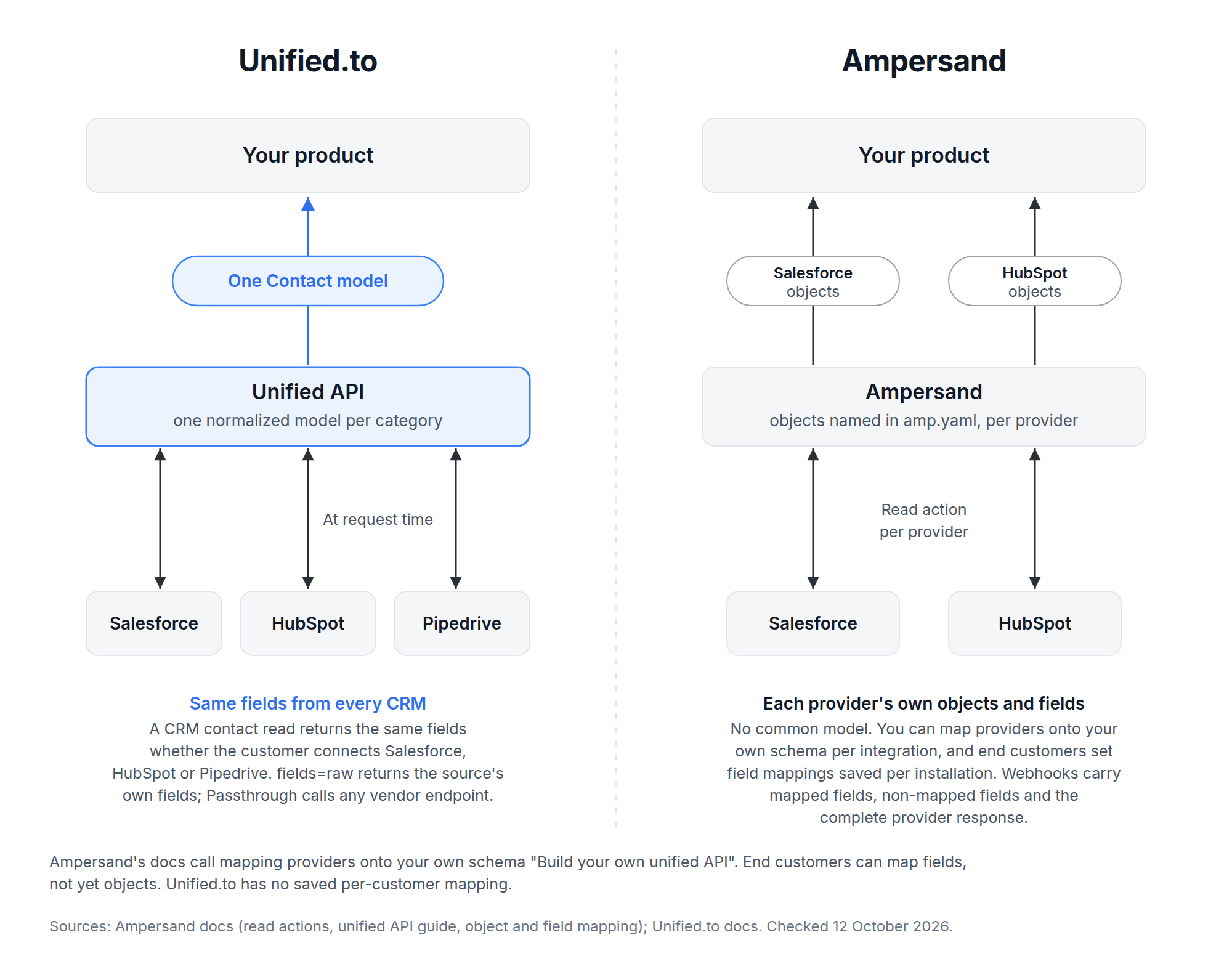
Ampersand returns each provider's own objects and field names, which you can map onto a schema of your own per integration, while Unified.to maps every integration in a category to one normalized model and reaches the rest of each vendor's API through raw fields and Passthrough.
Ampersand (as of 12 October 2026)
- Provider-native objects. Object names in
amp.yamlshould "match the name of the object in the official documentation for the SaaS API" (read actions). Ampersand's docs call mapping providers onto your own schema "Build your own unified API", and every webhook carries "your mapped fields, non-mapped fields, and the complete provider response" (unified API guide). Write actions list the "standard and custom objects you want to write to" inamp.yaml(write actions). - Per-customer field mapping. End customers map fields in Ampersand's embedded component, and "each installation keeps track of the per-customer mappings" (overview). Field mappings only: "Currently, only user-defined field mappings are supported, not object mappings yet." (object and field mapping). Unified.to has no saved per-customer mapping.
- Custom fields. Ampersand can create custom fields in Salesforce and HubSpot: "only Salesforce and HubSpot support this feature at the moment." It also watches customer schemas for field changes, at most hourly (manage customer schemas).
- Raw data and proxy. Raw provider data is "Always included" (unified API guide), and a proxy action makes "passthrough API calls to the SaaS provider's API" (proxy actions). Its public provider registry declares proxy support on 218 of 242 entries, and its pricing page gates neither: the Startups plan includes "All supported connectors and integrations" (pricing).
- Limits. Filtered reads are Salesforce and HubSpot only.
Unified.to
- Normalized models. A CRM contact read returns the same fields whether the customer connects Salesforce, HubSpot or Pipedrive, and an Employee is the same across Workday, BambooHR and Gusto; user references in other categories point to that HRIS employee.
- Custom fields. The Metadata API lists custom-field definitions and, as of 1 October 2026, creates them on 17 integrations, including Salesforce; on HubSpot it lists and retrieves only. Custom fields appear in a
metadataarray on objects such as CRM contact, HRIS employee and ATS candidate. - Provider-native data.
fields=rawreturns the source's own fields, arawobject on a write sets them, and Passthrough calls any vendor endpoint on every integration, custom objects included. For how the two unified API designs differ, see pass-through vs. sync-based unified APIs.
How do Ampersand and Unified.to handle change events and data delivery?
Ampersand delivers provider events through Subscribe on a short list of providers and falls back to scheduled reads; Unified.to forwards native webhooks as the source sends them and adds virtual webhooks for sources without events. Both put the changed record in the event payload.
Ampersand (as of 12 October 2026)
- Subscribe. "Subscribe actions are supported for a subset of providers." (subscribe actions). Ampersand's public registry lists 17 such entries, including Salesforce Change Data Capture with an opt-in filter installed in the customer's org. HubSpot subscriptions can't report custom-field changes without a workaround set up through Ampersand support.
- Latency: Ampersand's pages disagree. Its docs say "Get webhooks when data changes (1-2 minutes latency)" (unified API guide) and that first events after installation take "1-2 minutes, and occasionally up to 10 minutes" (subscribe actions); its comparison page on unified APIs says its event-driven architecture "detects and delivers that change to your application in under one second" (Ampersand vs. unified APIs), as does an April 2026 Ampersand blog post on usage-based pricing.
- Scheduled reads. Elsewhere, a read schedule "can be as frequent as every 10 minutes" (read actions), with backfill of full history or the last N days.
- Destinations. Webhooks, Slack, S3, warehouses (ClickHouse, Snowflake, BigQuery, Redshift) and queues (Kinesis, Amazon SQS, Google Cloud Pub/Sub, RabbitMQ, Azure Service Bus) (destinations); Postgres is on its roadmap.
Unified.to
- Virtual webhooks. Virtual webhooks detect changes and deliver events at an interval you set per webhook, down to 1 minute on paid plans (60 minutes on the trial). Checks that find nothing aren't billed; each page delivered counts as one API call.
include_allloads history first. - Database Sync. On Grow, Pro and Scale, a webhook can write into your own MongoDB, MySQL, Postgres, MSSQL, MariaDB, Supabase or Snowflake database. It covers objects that have native or virtual webhooks; objects with no change events can't be kept current this way.
- Coverage. Support varies by integration and object; check each integration's Feature Support tab.
What happens to your customers' data in Ampersand and Unified.to?
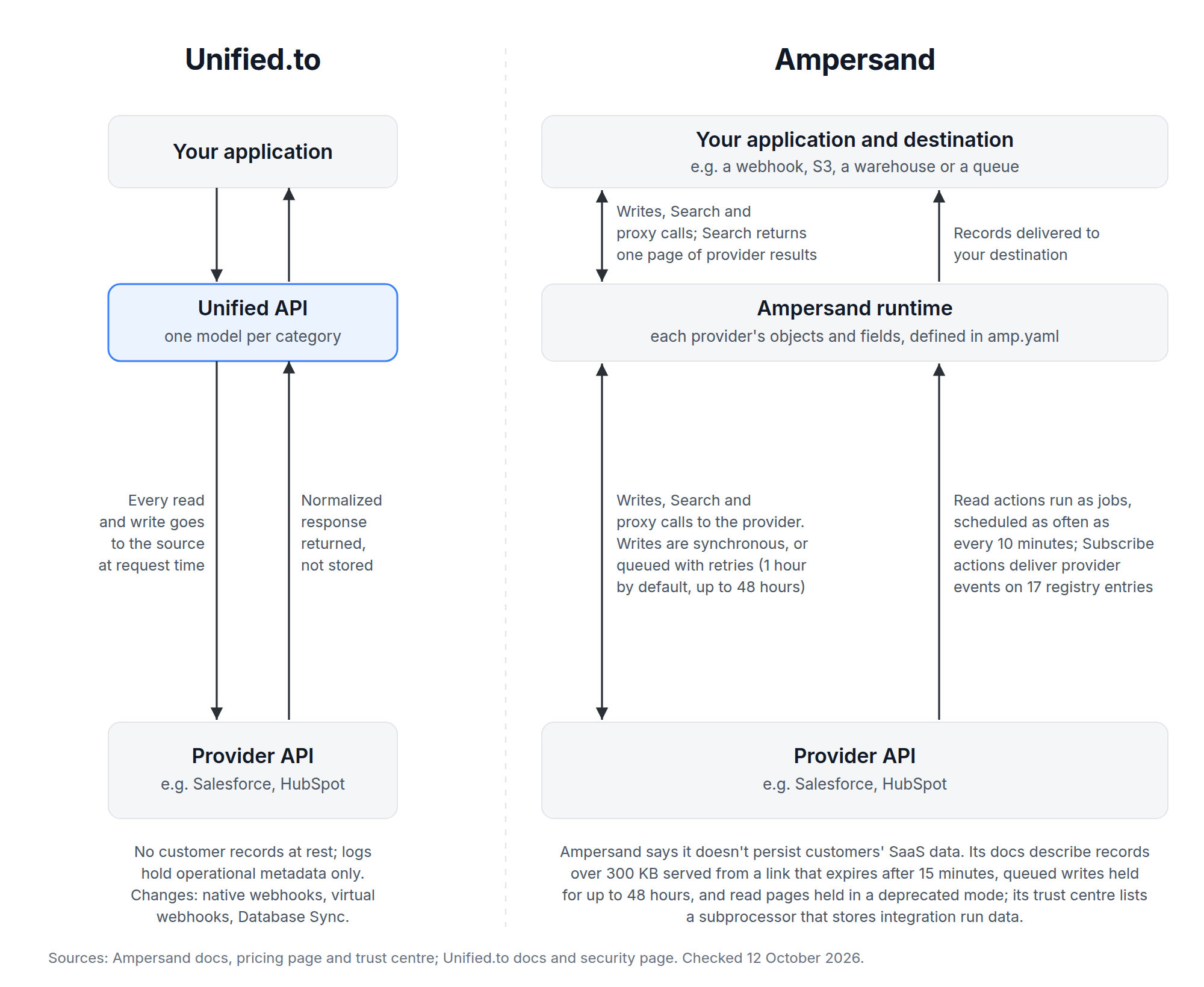
Ampersand says it does not persist customers' SaaS data, but its own docs and trust centre describe where read results, write payloads and run data are held; Unified.to keeps no customer records at rest. Ampersand's statements as of 12 October 2026:
- The claim. "Unlike unified APIs, we do not persist your customers' SaaS data. The only customer data that we persist is installation metadata, mappings, and access credentials that are necessary for the integration." (pricing FAQ)
- Held read results. In a deprecated delivery mode, "Ampersand will then hold the next 14 pages until you request for more results." (read actions). Records over 300 KB are served from a signed link: "The URL expires after 15 minutes." (webhook destinations)
- Held writes. Queued writes retry, and "you can specify a longer deadline of up to 48 hours" (write actions).
- Run data. Ampersand's trust centre lists ClickHouse as a subprocessor that "Stores integration run data, logs, and analytics used to operate and monitor Ampersand's services." Log retention is a per-project setting with no published default, and no page says whether logs exclude payloads.
Unified.to
- Records. Unified.to calls the source API at request time and stores no customer records; connection credentials are encrypted at rest.
- Logs. Logs hold endpoint, timing, status and workspace, never payloads, and are kept 60 days on Grow and Pro and 365 days on Scale.
- Virtual webhooks. They keep a read position, not records: a failed delivery re-reads the page from the source.
- Native webhooks. Payloads sit briefly, encrypted, on a processing queue before dispatch.
How do writes compare between Ampersand and Unified.to?
Ampersand writes provider-native objects, synchronously or as queued jobs with retries; Unified.to writes in the normalized model, one record per call, with no batch or bulk write method.
Ampersand (as of 12 October 2026)
- Modes. Synchronous writes return the record; asynchronous writes return an operation ID and retry for 1 hour by default, up to 48. Auto-batching groups queued single-record writes.
- Batches. "You can include 1-100 records per batch." and "Batch write is currently only supported for HubSpot and Salesforce." (write actions). Deletes are also Salesforce and HubSpot only, single-record and off by default.
- Accounting objects. Write lists are published per provider: QuickBooks Online 33 objects, Xero 15 (no
paymentsobject), and Sage Intacct lists 372 objects as read and write (QuickBooks, Xero).
Unified.to
- One write for many systems. One create call adds an invoice or contact in whichever system the customer connected. As of 12 October 2026, Unified.to writes invoices on 48 accounting integrations, including QuickBooks, Xero, NetSuite, Sage Intacct, Microsoft Dynamics 365 Business Central and MYOB, bills on 26 and contacts on 105. QuickBooks Desktop writes 10 accounting objects and Sage 100 (US) updates contacts and creates and updates sales orders.
- Payments. Payment writes go through the Payments category: 23 integrations as of 12 October 2026, including QuickBooks, Xero and NetSuite.
Which integration categories do Ampersand and Unified.to cover?
Unified.to lists more integrations and categories, 2300 in 39, against Ampersand's 181 catalogue entries in 15 categories; Ampersand's catalogue is weighted toward CRM, sales and marketing, and lists five accounting and ERP systems and two in HR and recruiting.
Coverage by category: Ampersand catalogue (counted 12 October 2026) and Unified.to integrations
| Category | Ampersand entries | Of which "Auth and proxy" guides | Ampersand examples | Not found at Ampersand | Unified.to integrations |
|---|---|---|---|---|---|
| CRM | 25 | 1 | Salesforce, HubSpot, Microsoft Dynamics CRM, Pipedrive, Attio, Zoho | n/a | 341 |
| Accounting and ERP | 5 | 0 | NetSuite, QuickBooks, Sage Intacct, Dynamics 365 Business Central, Xero | QuickBooks Desktop (no on-premise agent or desktop-software integration), Sage 100 (US), MYOB | 377 |
| HR and recruiting | 2 | 0 | Lever, Ashby (both ATS); Workday is featured as an auth-and-proxy integration, Gusto has a provider guide, BambooHR is in its registry only | ADP Workforce Now, Rippling, Paychex | 951 HRIS; 186 ATS |
| Ticketing | 16 | 2 | Zendesk Support, ServiceNow, Intercom, Freshdesk, Gorgias | n/a | 70 |
| Calendar and call recording | 17 | 1 | Gong, Google, Microsoft, Calendly, Fireflies | n/a | 110 |
| Messaging | 12 | 5 | Slack, Discord, RingCentral, Zoom, Aircall | n/a | 157 |
| Marketing | 43 | 13 | Outreach, Salesloft, Marketo, Klaviyo, Braze | n/a | 176 |
| Tasks and projects | 18 | 12 | Asana, Monday, ClickUp, Linear, Notion | n/a | 178 |
| Payments | 15 | 5 | Stripe, Chargebee, Recurly, Paddle, Zuora | n/a | 203 |
| File storage and documents | 10 | 6 | Box, Dropbox, Docusign, Ironclad | n/a | 126 |
| Code repositories | 6 | 0 | GitHub, GitLab, Bitbucket, Atlassian | n/a | 12 |
| Each row groups Ampersand's catalogue entries under the closest Unified.to category; some Ampersand entries sit in other Unified.to categories, such as Call Center or E-Signature. Ampersand counts are entries on its integrations page on 12 October 2026, each in one category; the "Auth and proxy" column counts entries whose guide sits in that section of its provider guides, described as "Managed authentication and proxy access to the provider's API." (67 of 199 guides). Ampersand's own totals differ by page: 150+, 200+ and 250+, and 242 in its public provider registry (llms.txt), a count that includes sandbox, demo and auth-method variants such as quickbooksSandbox and salesforceJWT. Unified.to figures: Unified.to integrations. |
How do Ampersand's MCP server and Unified MCP compare for AI agents?
As of 12 October 2026, Ampersand's docs say "The Ampersand MCP server is in alpha." and the server takes an API key in the client's configuration; Unified MCP is generally available over Streamable HTTP, scoped to one end-customer connection, with its tools reading and writing the normalized model.
Ampersand (as of 12 October 2026)
- Hosted MCP server. It is reached at
mcp.withampersand.com/v1/sse, scoped to a project, integration and customer group, and takes an API key in anx-api-keyheader; "If your MCP client does not support headers, you can pass the API key in the query param" (MCP server). It can also run locally over stdio (MCP server README). - Tools. Eight tools shared with the AI SDK, such as createRecord, updateRecord, sendReadRequest and startOAuth. Ampersand publishes no MCP spec revision, tool filtering or PII redaction.
- AI SDK. "The Ampersand AI SDK is in alpha." It is TypeScript, for the Vercel AI SDK and Mastra (AI SDK).
- Coding agents. Builder MCP creates and troubleshoots integrations, and Docs MCP answers docs questions (AI IDE set-up); Andi, for support and solutions teams, is in beta on Growth.
Unified MCP, generally available over Streamable HTTP rather than in alpha over SSE
- Transport. Streamable HTTP only; stdio-only clients use
mcp-remote. It supports MCP revisions 2024-11-05 through 2025-11-25, plus the stateless 2026-07-28 revision in production. Each region has its own host (UShttps://mcp-api.unified.to/mcp, EUhttps://mcp-api-eu.unified.to/mcp, AUhttps://mcp-api-au.unified.to/mcp), and a credential works only on its own region's host. - Connection-scoped tokens. A signed token, sent as a Bearer token in the Authorization header, grants one connection and nothing else, so the workspace API key stays on your server. RFC 9728 protected-resource metadata lets MCP clients discover how to authenticate.
- Tool control.
permissions(named scopes, such as read-only CRM) andtools(IDs or patterns) narrow the list,defer_toolsmarks tools for deferred loading, andhide_sensitivestrips sensitive (PII) fields such as names, emails, phone numbers, addresses, date of birth, SSN/SIN and compensation, plus credential fields, from results; it is opt-in. - Events. As of 26 October 2026, a connection's MCP server also supports the draft MCP Events extension: an agent calls
events/list,events/pollorevents/subscribeto learn when records change, instead of re-reading them. Events are offered on connection servers, not in Core mode; streamed delivery (events/stream) is not supported. - What one agent sees. The 242,210 total is the catalogue across all integrations; an agent sees only its connection's tools. As of 12 October 2026, one HubSpot connection carried 69 tools, 30 of them CRM. Models cap how many tools they handle well: Groq 10, most OpenAI models 20 and Cohere about 50, per Unified.to's docs.
- Outside MCP.
GET /toolsreturns the same tools in OpenAI, Gemini, Cohere, Grok and Groq formats; for Anthropic, requesttype=openaiand renameparameterstoinput_schema. Each tool call and eachevents/pollcounts as one API call on your plan, and each delivered MCP event counts like a webhook delivery (Unified MCP documentation). The same tools are also published as a UTCP manual at/utcpon each regional API host, for UTCP clients that call them over plain HTTP. - Coding agents. A Core MCP server manages workspace configuration and does not read or write end-customer data; Agent Skills teach coding agents to build against each Unified.to API and to register your own OAuth app with vendors' developer portals.
Where can Ampersand and Unified.to run?
Both Ampersand and Unified.to offer self-hosted or private deployments on Enterprise plans; below Enterprise, Ampersand runs in its own cloud with EU deployment reserved for Enterprise, while each Unified.to workspace runs in one region: the US, EU or AU on every plan.
- Ampersand cloud. Runs on Google Cloud Platform, with AWS for part of the Salesforce data flow; its 19 subprocessors are listed in the United States (trust centre), and its status page lists EU components alongside its default ones.
- Ampersand Enterprise. The pricing page lists "BYOC and Self-Hosted options" and "EU deployment and data residency options", and says "We can deploy Ampersand in your Google Cloud or AWS account." (pricing). As of 12 October 2026, Ampersand publishes no technical documentation for BYOC or self-hosting.
- Unified.to hosted. Multi-Region Sync on Scale keeps account configuration consistent across regions.
- Unified.to Enterprise. On-prem, private cloud, dedicated cloud or single-tenant hosting, including Unified MCP, which runs as part of the Unified API (Unified.to security).
How do end-user authorization and credentials work in Ampersand and Unified.to?
Ampersand and Unified.to both support your own OAuth app, so the consent screen carries your brand; they differ in frontend framework support and in where credentials can be kept.
Ampersand (as of 12 October 2026)
- Components.
InstallIntegrationhandles connection and configuration, including field mapping. "The Ampersand UI library requires React v18+." (embeddable UI components); "The Headless UI library is in beta." (headless UI) Frontend calls use an API key or a JWT with a maximum 10-minute lifetime. - OAuth apps. You register an OAuth app with each provider; Ampersand documents no shared apps, and some providers, such as Gong and Outreach, require a partnership first. Ampersand's OAuth guides register its callback URL, such as
https://api.withampersand.com/callbacks/v1/oauth, and no custom auth domain is documented. - Credentials. Encrypted in transit and at rest with key rotation; no customer-managed secrets store is documented.
Unified.to
- Flows. OAuth 2.0 and 2.1, with embedded authorization components for React, Angular, Vue, Svelte and plain JavaScript. An authorization CNAME on Pro and Scale puts the authorization URL on your own domain (US and EU regions).
- Credentials. Connection credentials are encrypted at rest, or kept in your own secrets manager on Pro and Scale: 11 types, including AWS, Azure, Google Cloud Secret Manager, HashiCorp, 1Password, Bitwarden and Doppler. More detail: how to handle OAuth across many integrations.
How does Ampersand's pricing compare with Unified.to's?
Ampersand and Unified.to both price on usage rather than per customer connection; Ampersand bills per action and publishes no prices on its pricing page (as of 12 October 2026), while Unified.to bills per API call from $750 a month with unlimited connections.
| Plan level | Ampersand (as of 12 October 2026) | Unified.to (as of 12 October 2026) |
|---|---|---|
| Entry | Startups: "Available through our startup program" | 30-day free trial on Grow and Pro; a free Test plan for non-production use (30 days, 10,000 API calls a month) |
| First paid level | Growth: no published price; Ampersand's proposal sets included action volume and usage rates for every plan; new connectors on request (also on Enterprise) | Grow: from $750 a month; 750,000 API calls a month, then $1.00 per 1,000; unlimited connections |
| Mid level | None published | Pro: from $1,500 a month; 2,000,000 API calls a month, then $0.75 per 1,000; unlimited connections |
| Upper level | Enterprise: custom | Scale: from $3,000 a month; 6,000,000 API calls a month, then $0.50 per 1,000; unlimited connections. Enterprise: usage-based or connections-based, by quote |
| Billed unit | Actions: each read batch delivered, successful write, Subscribe event delivered, successful search and successful proxy call | API calls, including each MCP tool call and each webhook page delivered; empty checks aren't billed |
| Sources: Ampersand pricing; Unified.to pricing. Ampersand's pricing page says "Custom plans for your usage, systems, and deployment requirements." A cost comparison at a given volume isn't possible from public pages. For how per-call and per-connection pricing behave as you grow, see usage-based vs. per-connection pricing. |
How do Ampersand and Unified.to compare on security and compliance?
Ampersand and Unified.to both hold SOC 2 Type II reports and list GDPR, CCPA and HIPAA; they differ on certifications, Canadian privacy law, BAA terms and which plan carries each access control.
Security and compliance (checked 12 October 2026)
| Capability | Ampersand | Unified.to |
|---|---|---|
| SOC 2 Type II | Report on request in its trust centre; SOC 3 report public | Report on request through its trust centre |
| ISO 27001 | ISO/IEC 27001:2022; certificate public in its trust centre | Not held |
| HIPAA and BAA | HIPAA listed; no BAA offer published | HIPAA compliant; BAA on Scale |
| GDPR and CCPA | Both listed; EU representative appointed under GDPR Article 27 | GDPR and CCPA/CPRA |
| PIPEDA | Not mentioned | Compliant |
| SSO and SCIM | SSO mentioned in a blog post, not in docs; no SCIM documented | SAML SSO on Pro and Scale |
| IP controls | Three fixed outgoing IPs for providers' allowlists | IP restriction on Pro and Scale |
| Logs | Retention set per project, no published default; no log shipping documented | Operational metadata only; 60 days (Grow, Pro) or 365 days (Scale); shipping to Datadog, Grafana, ClickHouse, Splunk or a syslog server on Pro and Scale |
| Uptime SLA | Terms disclaim uninterrupted or error-free service; one blog post mentions "99.9 percent with credits" | None on Grow, Pro or Scale; SLAs through Enterprise |
| Encryption | Credentials encrypted in transit and at rest, with key rotation | Connection credentials encrypted at rest; operational metadata encrypted at rest with AES-256; TLS 1.2 or later in transit |
| Sources: Ampersand trust centre; Ampersand pricing; Ampersand terms; Ampersand blog post on usage-based billing platforms; Unified.to security. |
Which companies build on Unified.to?
HoneyBook is a Unified.to customer. Anton Zaides, Engineering Manager at HoneyBook, describes working with Unified.to: "The responsiveness from Unified and the willingness to adapt to what we needed stood out. It's the best turnaround I've seen on requests and questions."
Should you choose Ampersand or Unified.to?
Choose Ampersand when your product needs provider-native objects on a few systems of record, such as Salesforce, HubSpot, NetSuite or Sage Intacct, delivered into your own warehouse or queue; choose Unified.to when your product reads and writes the same records across many vendors in a category, such as CRM, HRIS, ATS or accounting.
| If you need... | Choose | Why (as of 12 October 2026) |
|---|---|---|
| Field mappings each end customer sets, saved per installation | Ampersand | Set in Ampersand's embedded component; Unified.to has no saved per-customer mapping |
| Provider-native objects defined in config for a few systems of record | Ampersand | Provider objects named in amp.yaml, from published lists such as Sage Intacct's 372 objects; on Unified.to, objects outside the model are a Passthrough call |
| To create custom fields in HubSpot | Ampersand | Ampersand creates them on HubSpot; Unified.to's Metadata API lists them there but doesn't create them |
| Records delivered to BigQuery, Redshift, ClickHouse, S3 or a queue | Ampersand | Both deliver to Snowflake; Ampersand adds BigQuery, Redshift, ClickHouse, S3 and queues |
| Batch writes to Salesforce or HubSpot | Ampersand | 1 to 100 records per batch; Unified.to has no batch or bulk write method |
| Deployment into your own Google Cloud or AWS account | Ampersand | Listed as BYOC on Enterprise; Unified.to's Enterprise options are on-prem, private cloud, dedicated cloud or single-tenant |
| ISO 27001 | Ampersand | ISO/IEC 27001:2022; Unified.to does not hold it |
| Every endpoint of one system, because every customer uses the same vendor | Ampersand or a direct integration | A cross-vendor model adds little when there is one vendor |
| One model across every CRM, HRIS, ATS or accounting system your customers use | Unified.to | Ampersand has no common model; you name and map each provider's fields |
| ADP Workforce Now, Rippling, Paychex, QuickBooks Desktop, Sage 100 (US) or MYOB | Unified.to | Not in Ampersand's catalogue or registry |
| Change events from systems without native events, checked as often as every minute | Unified.to | Virtual webhooks at a 1-minute minimum on paid plans; Ampersand's scheduled reads run every 10 minutes at best |
| To read normalized records at request time from your own code | Unified.to | Ampersand's read actions run as jobs delivered to a destination, its synchronous Search "returns only a single page of provider results", and its proxy returns each provider's own format |
| Published prices and a trial on the pricing page | Unified.to | Grow, Pro and Scale prices and a 30-day free trial on Grow and Pro; a free Test plan for non-production use (30 days, 10,000 API calls a month); Ampersand's pricing page publishes no prices or trial |
| A production MCP server, server SDKs beyond TypeScript, or a non-React frontend | Unified.to | Ampersand's MCP server and AI SDK are alpha, and its components are React only; Unified.to ships seven SDKs |
| EU or AU hosting below Enterprise, or your own secrets manager | Unified.to | EU or AU on every plan, your own secrets manager on Pro and Scale; Ampersand's EU deployment is on Enterprise |
| The answer can differ by feature inside one product: a Salesforce sync that each customer maps to their own custom fields may point to Ampersand, while a feature that reads the same records from every customer's HR or accounting system points to Unified.to, and a product can use both. For another head-to-head, see StackOne vs. Unified.to. |
Frequently asked questions
What if I want AI access to my own company's SaaS tools rather than to build a product?
Use UnifiedMCP, which Unified.to operates for individuals and internal teams who want to connect ChatGPT, Claude, Gemini or Cursor to their own accounts, such as Salesforce, HubSpot, Slack, Stripe and Notion, without writing code. Ampersand's llms.txt says: "It is for integrations shipped inside a product, not internal workflow automation or warehouse ETL."
What happens to my customers' connections if I leave?
On Unified.to, the API returns each connection's tokens, and tokens issued to your own OAuth app keep refreshing after you leave, so your customers don't reconnect. Ampersand also lets you leave with your credentials: as of 12 October 2026 its pricing page says "You can also export API keys and OAuth tokens at any time", and it imports existing tokens. Moving from another unified API or integration platform? Unified.to's migration guides map authorization, API calls, pagination, webhooks and passthrough, and cover re-authorizing customers or importing credentials from your own OAuth apps.
For more ways to give agents access to your customers' SaaS data, see Best Tools for Giving AI Agents Access to SaaS APIs.
Start your 30-day free trial of Unified.to or book a demo to see how the coverage and architecture fit your product.
Written by Mallory Greene.
About the author: Mallory Greene is Head of Marketing at Unified.to_. She writes about integration infrastructure, unified APIs, and MCP for technical teams. Based in Toronto._